

Malcolm Gardner, Visionary Network Ltd
The local election results were not simply a bad night for some parties and a good night for others. They were a warning about the fragility of local government at a time when councils are already under severe pressure.
The results showed a sharp fragmentation of local politics. Reform UK made significant gains, including control of Essex County Council, Sunderland and Havering. Labour lost heavily in a number of areas and lost control of Birmingham. Greens, Liberal Democrats and independents also gained ground in different parts of the country. This was not a straightforward swing from one traditional party to another. It was a much more unsettled political picture, with voters expressing anger, frustration and a desire for change in several different directions[i].
That is democracy. Voters are entitled to remove people they no longer trust. They are entitled to elect people who better reflect their concerns, their hopes or their anger. No party has a right to govern a council indefinitely. No long serving councillor has a right to remain in office because they know the system. Local government needs challenge. It needs renewal. It needs people who are willing to ask questions that insiders may have stopped asking.
But there is a difference between renewal and avoidable damage. There is a difference between bringing fresh thinking into the council chamber and assuming that strength of feeling is a substitute for knowledge.
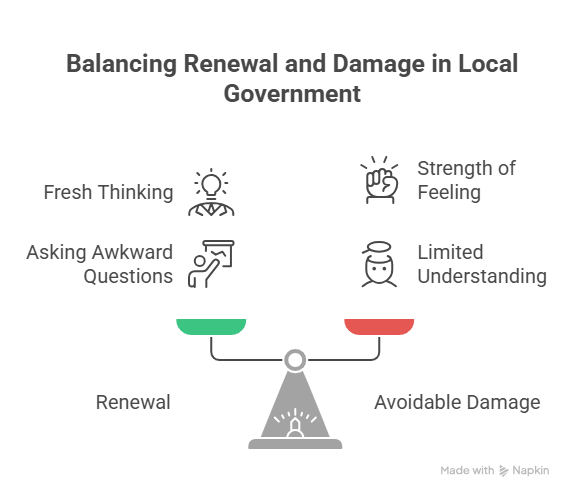
The risk now is not that new councillors will ask awkward questions. They should. The risk is that many councillors may arrive with limited understanding of how local government is funded, what councils are legally required to do, how services operate, where money is already committed, and how little room for manoeuvre there often is.
Local government is not a debating society. It is not a social media thread. It is not a conversation in a public house where every difficult issue can be solved by invoking common sense. Councils are statutory bodies. They collect taxes, administer benefits, protect children and vulnerable adults, house people in crisis, inspect food premises, collect bins, maintain roads, regulate planning, run elections, support public health, manage debt, employ staff and spend very large sums of public money.
A councillor can campaign in slogans. They cannot govern in slogans.
The loss of institutional memory
There is also another risk in the election results that should not be dismissed as sour grapes from those who lost.
Across the country, councils have not only seen changes in political control. Many have also lost experienced councillors, from different parties and from none, who carried a great deal of local knowledge, civic memory and practical understanding.
Some were cabinet members. Some were committee chairs. Some were scrutiny leads. Some served on planning, licensing, audit or governance committees. Others were ward councillors who had spent years understanding complex local issues, difficult relationships, past commitments and unresolved tensions.
That loss matters.
Experienced councillors are not automatically better councillors. Length of service does not guarantee wisdom, openness or good judgement. Some long serving councillors become too comfortable. Some become too defensive. Some become too close to the system they are meant to challenge.
But many experienced councillors provide something that is often invisible until it disappears: continuity.
They know why a decision was taken several years earlier. They know what was promised to residents. They know where a project has already failed once before. They understand the history behind a planning allocation, a regeneration scheme, a transport proposal, a school place pressure, a housing dispute or a long running financial risk. They know which local partnerships are fragile. They know which community groups need careful handling. They know where legal, financial or reputational problems may be sitting below the surface.
When large numbers of those councillors are removed at once, councils may lose more than political leadership. They may lose memory.
That is particularly risky where experienced councillors had been leading, scrutinising or closely involved in major projects. Local government projects often take years. Regeneration schemes, housing programmes, waste contracts, devolution discussions, local government reorganisation, social care transformation, SEND improvement plans, transport schemes, estate renewal, digital programmes and budget recovery plans all depend on continuity.
A new councillor may inherit a project at the point where the public sees only a controversial decision. They may not yet understand the legal commitments already made, the funding deadlines, the procurement constraints, the risks of withdrawal, the promises made to partners, or the consequences of delay. They may understandably want to review everything. Sometimes that will be right. But sometimes reopening old arguments can add cost, create uncertainty, damage relationships and expose the council to avoidable risk.
Nor is it enough to say that officers will simply fill the gap.
Officers hold professional, technical and operational knowledge. They are essential to continuity. But they cannot, and should not, replace elected political memory. Officers can explain the papers, the process, the legal duties and the risks. They can brief new members on the background. They can advise on what has happened and what options remain. But they cannot recreate the democratic judgement that comes from elected members having lived through earlier debates, compromises and public commitments.
There is also a constitutional point. Councillors are not merely consumers of officer advice. They are decision makers. If the political side of the council loses too much experience too quickly, the balance can shift in unhealthy ways. Officers may become over relied upon to provide direction, which can blur accountability. Alternatively, inexperienced councillors may reject sound advice because they do not yet understand the history behind it. Both outcomes carry risk.
The most effective councils are not officer led or member led in some simplistic sense. They work because experienced officers and informed elected members understand their different roles. Officers bring professional advice, evidence and operational realism. Councillors bring democratic judgement, political direction and local accountability. When one side loses too much capacity, the whole system becomes weaker.
This is why political transition needs to be treated as a governance risk, not just a democratic event. New administrations need structured induction, serious briefings, access to project histories, honest risk registers and time with senior officers. They also need the humility to recognise that a committee report rarely contains the whole story.
The public may have voted for change, but they did not vote for avoidable amnesia.
The funding trap
One of the first shocks for many new councillors is that council finance does not work as the public often assumes.
Council tax is highly visible, but it is only one part of the funding picture. Government grant, business rates, fees, charges, ringfenced grants, reserves, borrowing rules and statutory restrictions all sit behind the budget. Some funding can be used only for specific purposes. Some costs are driven by demand rather than choice. Some pressures cannot simply be removed because a new political group has arrived.
The Local Government Association’s finance guidance for councillors makes clear that members have responsibilities in relation to council finances, including the legal and governance framework within which money is raised, managed and spent[ii].
This is where many campaign promises meet reality.
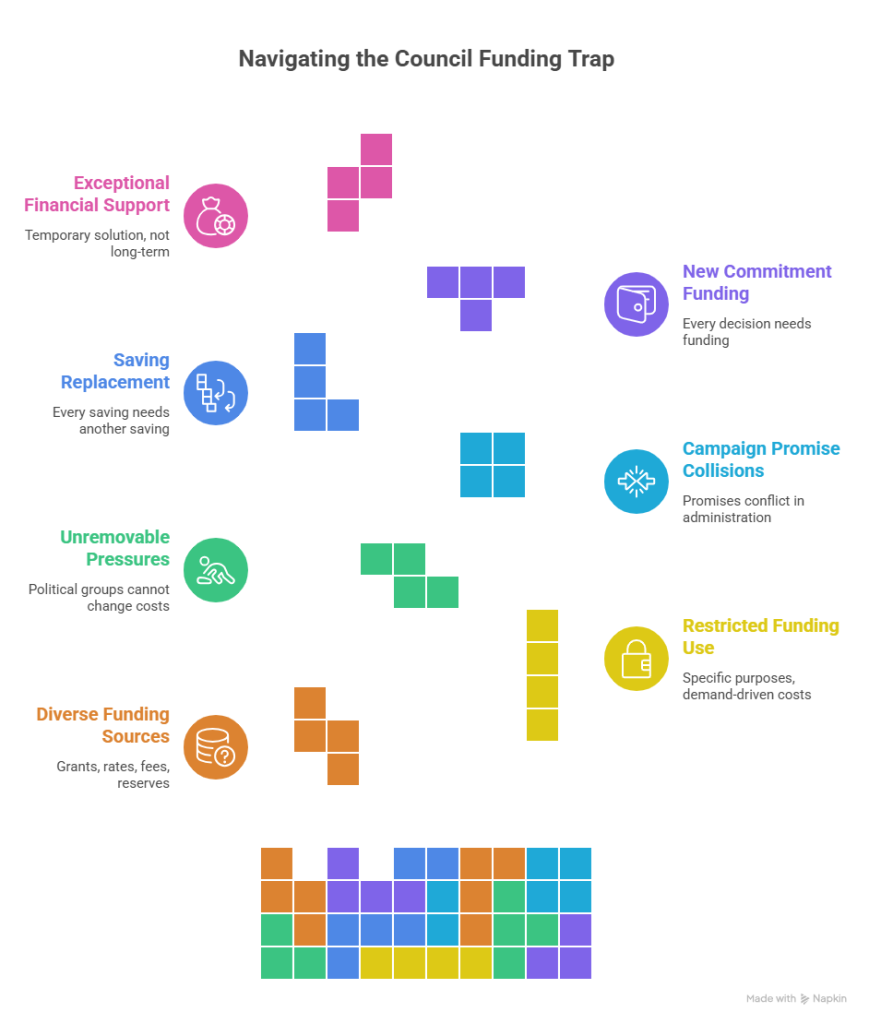
A candidate may promise to cut council tax, restore libraries, stop parking charges, increase street cleaning, reopen youth services, protect every green space, improve special educational needs transport, reduce debt recovery, freeze fees and stop all unpopular development. In opposition, those promises can sit beside each other. In administration, they collide.
Every avoided saving has to be replaced by another saving, more income, lawful and prudent use of reserves, or a reduction somewhere else. Every new commitment needs to be funded. Every decision has consequences.
This would be challenging in normal times. These are not normal times.
The National Audit Office reported in 2025 that 42 local authorities in England had received exceptional financial support, with 30 of those receiving support to balance their 2025 to 2026 budgets. The NAO also warned that such support may help councils through an immediate budget problem but does not solve the deeper financial pressures facing the sector[iii].
That is the environment into which many newly elected councillors are stepping.
The problem with arriving certain
There is nothing wrong with conviction. Most people who stand for public office do so because they care about something. They may care about immigration, the environment, planning, road safety, housing, public spending, tax, town centres, social care, special educational needs, waste collection or local identity.
The difficulty begins when conviction becomes certainty before the facts are known.
Many candidates arrive having campaigned on individual cases. A resident has been refused housing. A business has been chased for rates. A family has been told they are not entitled to council tax support. A planning application has been approved despite objections. A disabled person has not received the service they believe they should have received. A debt has been passed to enforcement agents. A road has not been repaired. A bin has not been collected.
From the doorstep, the case may look obvious. From inside the system, it may look very different.
The resident who says they received no help may have refused support. The council accused of ignoring evidence may have been applying national regulations. The planning decision that appears to defy common sense may have been constrained by planning law. The benefit decision that feels harsh may have been driven by income, capital, household composition or statutory rules. The service cut that appears ideological may have been caused by the need to protect children’s services, adult social care, homelessness support or SEND transport.
The hard lesson in local government is that residents can be sincere, distressed and still wrong about the facts. Councils can be legally correct and still produce outcomes that feel unfair. Councillors have to live in that uncomfortable space.
Representing everyone
New councillors also discover quickly that they do not represent only those who voted for them.
They represent the person who put up their poster and the person who called them dangerous. They represent the resident whose views they dislike and the resident who blames them for everything wrong in the country. They represent landlords and tenants, motorists and cyclists, homeowners and homeless households, parents and people without children, businesses and complainants, older residents and young adults who feel ignored.
That is not an optional courtesy. It is the essence of civic office.
The job is not to reward supporters and punish opponents. It is to act lawfully, fairly and in the interests of the area as a whole. A councillor who treats the role as tribal warfare will damage not only their own reputation, but also the council’s capacity to govern.
This matters particularly where councillors have campaigned around grievance. They may have promised to be on the resident’s side. But being on a resident’s side cannot mean ignoring evidence, bypassing policy, bullying officers, prejudging quasi-judicial decisions, or pretending that the council has powers it does not possess.
Sometimes the honest answer to a resident is: I understand why you are upset, but I cannot get you the outcome you want.
That is one of the most difficult things in public life.
When your own policy hurts your own residents
There is another uncomfortable moment that awaits many councillors: discovering that a policy they support in principle may hurt people they also promised to help.
A councillor may want tougher action on fly tipping, until a vulnerable resident is caught by the policy. They may support stronger council tax enforcement, until they meet a working family trapped by irregular income and fluctuating Universal Credit payments. They may want stricter planning control, until a local business cannot adapt its premises. They may campaign for traffic restrictions, until disabled residents, carers or small traders explain the practical impact. They may demand lower council tax, until they see what that means for adult social care, homelessness prevention or neighbourhood services.
This is not hypocrisy. It is the reality of public administration.
Policy is easy when discussed among people who broadly agree with each other. It is much harder when it meets the messy reality of residents’ lives. Unintended consequences are not rare in local government. They are a constant risk.
Experienced councillors learn to ask: who benefits, who loses, who is not in the room, what are the legal duties, what does the evidence show, what will this do to the budget, and what happens in future years?
Inexperienced councillors often ask only: does this match what I promised?
Officers are not the enemy
One of the quickest ways for a new administration to fail is to confuse officer advice with obstruction.
Officers are not elected. They should not make political choices that belong to councillors. But they are responsible for giving professional advice, warning of legal risk, protecting public money, explaining operational consequences and ensuring that the council acts within the law.
A monitoring officer who warns against a course of action is not necessarily being negative. A section 151 officer who says the numbers do not work is not undermining democracy. A director who explains that a service cannot be redesigned quickly without unacceptable risk is not defending the old regime.
They may simply be doing their job.
Of course, officers can be wrong. Councillors should challenge them. They should ask for options, evidence, alternatives and clearer explanations. But if every warning is treated as sabotage, the council moves from political change into institutional instability.
Good councillors learn how to test officer advice without humiliating officers. Good officers learn how to explain constraints without sounding as though they are closing down political choice. That relationship is essential.
The Birmingham warning
Birmingham is an extreme example, but it is also a warning.
Labour lost control of Birmingham after 14 years, with gains by Reform, Greens and independents. This came after a period in which the council had faced severe financial and operational problems, including its 2023 effective bankruptcy, service reductions and an ongoing bin dispute.
That is the scale of what local government can involve. It is not just ward casework and public statements. It is equal pay liability, waste contracts, statutory services, workforce relations, children’s services, adult social care, homelessness, capital programmes, regeneration, audit, governance, procurement and public trust.
A fragmented council can still govern well, but only if councillors understand the seriousness of the institution they have entered. If they treat the chamber as a permanent campaign platform, the result can be paralysis.
Voters may enjoy seeing established parties punished. They will not enjoy missed bins, failed services, unlawful decisions, unmanaged debt, collapsing governance or higher bills caused by avoidable mistakes.
Disruption at the worst possible time
This political disruption is happening while local government is already facing structural upheaval.
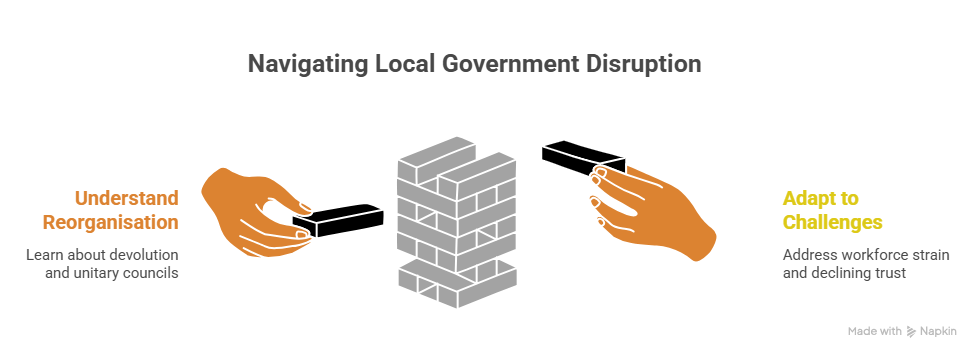
The government’s English Devolution White Paper set out proposals to extend devolution and support local government reorganisation, including movement away from remaining two tier structures in areas where change is considered necessary[iv]. The Institute for Government has also described local government reorganisation as the replacement of county and district arrangements with unitary councils in affected areas. [v]
So new councillors are not arriving at a stable system. They are arriving at a moment of financial pressure, rising demand, public anger, possible reorganisation, workforce strain and declining trust.
That makes learning quickly not desirable, but essential.
The dinner party problem
There is a particular danger in local politics: the illusion of knowledge.
Many people have views about councils because they use council services, pay council tax, read local Facebook groups or attend residents’ meetings. That gives them experience of local government from the outside. It does not necessarily give them understanding of local government from the inside.
A person may have spent years discussing planning, but never read a local plan, understood material considerations, or followed an appeal decision. They may have strong views about council tax, but no understanding of the collection fund, precepts, discounts, exemptions, council tax support, bad debt provision or enforcement regulations. They may think social care is inefficient, but never looked at legal duties, market fragility or safeguarding thresholds. They may think senior officers are overpaid but not understand the statutory responsibilities they carry or the consequences when councils cannot recruit competent finance, legal, planning, housing or social care staff.
Local government is full of subjects that look simple until you touch them.
That does not mean only experts should become councillors. It does mean councillors should arrive with humility. The most dangerous councillor is not the one who knows nothing. It is the one who knows nothing and thinks they know enough.
What new councillors need to learn quickly
The immediate task for new councillors is not to abandon their beliefs. It is to understand the machinery through which those beliefs must operate.
They need to understand that councils must act within the law. Political mandate does not override statutory duty.
They need to understand that budgets must balance. Spending commitments must be funded, not merely announced.
They need to understand that officers advise and councillors decide, but both have responsibilities.
They need to understand that casework is not the same as governance. Helping one resident must not create unfairness or illegality for others.
They need to understand that scrutiny is not theatre. It requires evidence, preparation and follow through.
They need to understand that consultation must be real. It cannot be a performance after the decision has already been made.
They need to understand that equality duties matter. Decisions can have unequal effects even when no unfairness was intended.
They need to understand that communications matter. Residents are more likely to accept bad news when they believe they are being told the truth.
Most importantly, councillors need to learn the difference between power and responsibility. Winning an election gives them authority. It does not give them unlimited freedom.
The opportunity
There is a positive side to this moment.
New councillors can bring energy. They can ask questions that insiders stopped asking years ago. They can challenge jargon, complacency and managerial drift. They can reconnect councils with residents who feel ignored. They can force councils to explain decisions better. They can expose poor performance. They can break unhealthy one-party cultures where scrutiny has become weak.
Local government should not fear new people. It should fear incurious people.
A council full of newly elected members who are willing to learn can be a powerful thing. A council full of newly elected members who are determined not to learn can be a disaster.
The difference will be seen in the first few months: whether they attend training, read papers, ask serious questions, listen to officers, respect legal boundaries, understand budgets, engage with residents beyond their own supporters, and accept that sometimes the responsible decision is not the popular one.
The mandate is only the beginning
The local elections were a message from voters. That message deserves to be heard. Many people are angry. Many feel services have declined while bills have risen. Many believe established parties have failed to listen. Many want something different.
But the election result is only the beginning.
The real test is not whether new councillors can win seats. They have done that. The test is whether they can govern.
Local government is where national rhetoric meets daily reality. It is where ideology meets the housing register, the care package, the empty reserve, the legal advice, the equality assessment, the procurement rule, the safeguarding duty, the planning inspector, the unpaid council tax bill and the resident who believed every word of the leaflet.
Those who have arrived in council chambers with strong views now have a choice. They can treat local government as another stage on which to perform anger. Or they can do the harder, less glamorous work of learning, listening, deciding and being accountable.
Change is not the problem. New councillors are not the problem. Fresh voices are not the problem.
The problem is the unknowing: not knowing the law, not knowing the finance, not knowing the operational consequences, not knowing what officers are trying to warn about, not knowing what cannot be delivered, not knowing the history of inherited projects, and not knowing that you do not know.
At a time of financial strain, service pressure and local government upheaval, that is a risk councils cannot afford.
[ii] Local Government Association
[iii] . National Audit Office NAO
© 2026 Malcolm Gardner ALL RIGHTS RESERVED