

From firefighting to reform
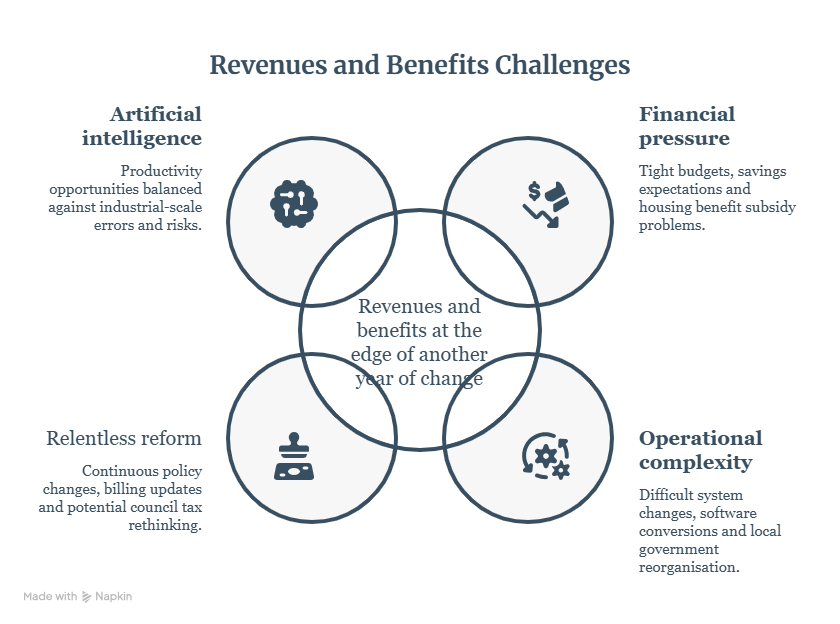
Revenues and benefits at the edge of another year of change
At the final Independent R&B Monday Discussion Group before the summer break, practitioners reflected on tight budgets, difficult system changes and relentless reform – then looked ahead to local government reorganisation, artificial intelligence and a possible rethink of council tax.
This article is based on the discussion held on 27 July 2026. Contributions and quotations have been lightly edited for clarity.
There was an unmistakable end-of-term feeling as Malcolm Gardner opened the final Independent R&B Monday Discussion Group before its August break. The jokes and good-natured exchanges suggested a room ready for summer, but the conversation that followed told a different story: revenues and benefits teams are carrying pressures that do not disappear when the calendar turns.
Malcolm invited the group to look back over the previous 12 months and ask a simple question: what had been the most difficult challenge? The answers quickly revealed a profession in which financial pressure, operational complexity and continuous reform have become inseparable.
Pressure that never leaves the desk
For Julie Smethurst, the hardest challenge was also the most familiar: the budget. Savings expectations felt, in her words, “a bit pie in the sky” – yet they remained on her desk and were likely to stay there for the foreseeable future. Naomi Armstrong connected the same financial pressure to continuing housing benefit subsidy problems, particularly those involving charitable organisations. Neither issue was new, but that was precisely the point: long-running difficulties were still consuming capacity while new demands arrived.
Michael Fisher’s defining challenge was a change of software system inherited from his predecessors. With a third and final data cut approaching and go-live planned for 28 September, he was facing his third major conversion. Previous experience may have helped him secure the role, he observed, but it had not made the process any easier. The Crisis Resilience Fund had added another layer of work.
That experience opened a wider discussion about local government reorganisation (LGR). Michael warned that even combining seven instances of the same system could be difficult; merging different systems, different versions and different local practices would be harder still. Sean O’Sullivan agreed. A common supplier name could disguise major differences in local operating processes, parameters, income codes and working practices. Treating a same-system migration as routine could therefore be more dangerous than approaching an obviously complex conversion.
Bob Wagstaff added that some proposed reorganisations would split existing councils between successor authorities, potentially dividing systems as well as combining them. Fisher described the emerging Hampshire arrangements as a “dog’s dinner”: boundary changes and different software packages would create a further layer of complexity. O’Sullivan argued that the logical technical response was a unified front end producing standardised data for whichever back-end system was ultimately chosen. Few councils had followed that route, he said, although it could reduce the risks of conversion.
What, if anything, became easier?
When Malcolm reversed the question and asked what had become easier, Robert Fox’s answer was blunt: not much. His own unresolved challenge had been persuading the NHS to pay around £3 million towards adult social care, while the wider budget struggle continued. Smethurst’s immediate answer was simply “nothing”.
Naiomi did, however, offer one example of a process that had gone better than feared. Her authority’s Council Tax Reduction (CTR) scheme had secured the support of members and precepting authorities, and consultation had gone well. Even after protest action forced one full council meeting to be abandoned, the scheme was approved within the required timetable. Once a scheme is settled it can become business as usual, she said, but authorities embarking on change should not underestimate the amount of work involved.
Robert’s authority was not planning wholesale CTR reform, but pressure for exceptions continued. Campaigns by the Royal British Legion in earlier years and Marie Curie more recently had required members to consider how the scheme should respond to particular circumstances. A change of administration and no overall control made those choices still more delicate.
Reorganisation, reform and the decisions behind the modelling
Looking ahead, Rachael Walker identified forthcoming billing changes and LGR as two of the largest challenges. The broad uncertainty over which reorganisations would happen might have reduced once decisions were made, she suggested, but it had been replaced by a much larger number of detailed uncertainties. Mobilisation had felt theoretical; now it was real, and colleagues in several councils looked like “rabbits in the headlights”.
Malcolm added the consequences of government funding redistribution. Some councils were facing sharp changes to their financial position, and a number could be dealing with redistribution and reorganisation at the same time. Rachael said the technical modelling was becoming easier, and members could increasingly see why change was necessary. The difficult part was no longer proving the need for action; it was deciding what support could be offered, what might not be collected and how the council’s budget could still be balanced. Better modelling did not make the underlying choices any less painful.
Bob saw another source of instability in the economic effects of the war in Iran and in proposals to replace council tax with a land value or proportional property tax. Even if reform lay beyond the next 12 months, councils would face questions about the quality of their property data while simultaneously planning new arrangements after LGR. He asked whether it made sense to redesign council tax administration for new authorities only to abolish the tax shortly afterwards.
Sean warned that the public debate itself could make collection harder. If people heard that a replacement tax would fall on landlords or owners, tenants might conclude prematurely that they no longer needed to pay council tax. The gap between an announcement, public understanding and legal implementation could create a new recovery problem before any reform took effect.
Housing policy formed part of the same picture. Malcolm noted that failure to meet housebuilding targets would affect revenues, benefits and local tax bases. Robert said Swindon needed economic growth to help close a £22 million budget gap and to replace the manufacturing capacity lost with the Honda plant. New drone manufacturers had provided an unexpected source of growth, but the wider dependency on development remained. Michael highlighted the clash between national housing commitments and local democratic opposition: few communities actively ask for thousands of new homes next door, even where the national mandate is clear.
Paul Howarth saw a new government prepared to reopen large questions about council tax, social care and housing that had long been deferred. That could create an enormous workload for local authorities. At the same time, departments were likely to be asked to find further savings to fund immediate political priorities. Reform and retrenchment, in other words, could arrive together.
“Always something else”: the cost of constant change
Asked what one thing she would change, Smethurst chose a return to a national CTR scheme. It would remove some local pressure and create breathing space for other priorities. Armstrong, facing the ticking clock of LGR, recognised that fixed deadlines were uncomfortable but necessary: without hard stops, decisions could drift indefinitely.
Lynne McMorris described a different kind of capacity problem. Demand for her company’s prevention work had grown rapidly, fuelled by the pressures on public sector clients. Commercially, that was positive; operationally, it meant recruiting quickly and bringing new colleagues up to speed while continuing to deliver. Growth was welcome, but it was also relentless.
For Michael, the pace of change had been broadly constant for more than a decade. The abolition of Council Tax Benefit, Storm Desmond, Covid, business grants and business rates reform had followed one another with little respite. He could not remember a genuinely quiet year since around 2012. The result was change fatigue: eventually, “one more thing” became one thing too many.
What he wanted was not an absence of ambition, but enough stability to review the service properly: its processes, its contact with residents and whether it remained fit for purpose. Instead, teams were forced into reactive, piecemeal responses. Smethurst described the same experience as permanent firefighting, leaving little time to think, plan or influence strategy.
Michael used falling collection rates as an example. Authorities had watched them decline for six years, yet few had been able to devote sustained attention to why it was happening or how the trend might be reversed. A new piece of software or a short burst of resource was not the same as a strategic response.
Paul reflected on the position of civil servants required to implement the policy of the government of the day, whether or not it matched their personal view. Clear ministerial direction at least made implementation easier. Michael contrasted that with local government’s experience of spending cuts: central government could reduce the cheque at the start of the year and leave councils to manage the consequences. Consultation might take place, he said, but local voices were rarely heard. As Gardner put it, consultation is not negotiation.
AI: productivity, accessibility and industrial-scale mistakes
The group’s most animated exchange concerned artificial intelligence. Naiomi expected much wider use across local and central government over the next year but did not believe organisations were ready. Too many people still blurred the distinctions between automation, machine learning and generative AI. Automation deserved a strong push, she argued; AI required a considered one.
Paul, previously sceptical, said Malcolm’s training course had made him more optimistic. The most constructive outcome would not necessarily be fewer jobs, but greater productivity from the same workforce. The technology sometimes produced strange results, but he believed it could become a genuinely useful tool.
Malcolm agreed, with a warning. Used well, AI could lift productivity; used badly, it could create unnecessary work and reproduce errors “on an industrial scale”. He had never seen a technology adopted so rapidly while remaining so poorly understood. Knowing how to press the button was not the same as understanding when, why or whether it should be pressed.
Robert was already seeing the downside in lengthy, apparently AI-assisted complaints. Simple queries could arrive as three or four pages citing expired regulations or rules that had never existed. That made them slower to resolve, not faster. Some authorities were considering a different route for clearly machine-generated complaints, he said, although he believed that approach was fraught with pitfalls.
Rachael saw both sides. AI could give people accessible language and the confidence to engage with institutions that otherwise felt unapproachable. It could also invent claims – such as the idea that Magna Carta invalidated council tax – with equal confidence. Training had greatly improved the effectiveness of her own use, while the systems themselves had become dramatically more capable. Her position remained deliberately unsettled: the opportunities and risks were changing too quickly for a fixed answer.
Malcolm noted that the capabilities of the leading tools had changed materially during a course lasting only ten weeks. By the same point next year, he predicted, the group would be having a very different conversation about AI in the workplace.
Who will collect, who will pay?
The final discussion moved from technology to the future shape of revenues and benefits. Howarth expected any Burnham government to pursue automation and better data sharing because the pressure to find money would be intense. He hoped the goal would be to do more with the same staff rather than simply to cut posts, while acknowledging that cheaper delivery would remain a powerful political demand.
Lynne anticipated a more local approach to employment and welfare support. Proposals affecting young people not in education, employment or training appeared to depend on voluntary work, training and locally available support. That suggested that some responsibilities could move back towards local delivery.
Bob believed the distinction between the ‘deserving’ and ‘undeserving’ had already been sharpening for years. From his experience of a food bank, however, he had also seen family demand fall substantially after changes to the child-related cap within Universal Credit. The lesson was disarmingly simple: when households had more money, they spent it on essentials such as food.
On tax reform, Bob wondered whether a land value or property tax might be administered nationally through HMRC and Land Registry rather than by councils. Recovery could shift away from enforcement agents and towards land charges or settlement on sale. That might leave local authorities primarily delivering services financed from the centre – an outcome that appeared to sit uneasily beside the rhetoric of devolution.
Malcolm suggested a hybrid model: a national framework with delivery or limited variation at regional level. Sean could see the attraction of decentralising power away from London, although he questioned how much that would alter the daily reality of local government. Rachael supported the regional idea as a ‘Goldilocks’ scale for many functions, but wanted property taxation to tackle the structural inequality between areas with strong and weak tax bases. If regional arrangements could do that, she would welcome them; if not, she preferred a national solution. Paul asked whether advocates of a national CTR scheme might find a regional scheme a more politically achievable step.
Robert brought the debate back to the human consequences of fragmented financial assessment. He had encountered a resident receiving 100 per cent CTR and Housing Benefit who was nevertheless assessed to pay £500 a month towards personal care. Increasing the charge did not create income if the person could not pay; it simply created a larger debt and could cause them to stop making even the payments they had previously managed.
Sean said adult social care recovery was limited because care could not be withdrawn. Different needs allowances across social care, benefits and local taxation produced contradictory judgments about affordability. An invoice could still appear as income even with little prospect of collection, leaving a gap that looked filled on paper while widening in practice.
Rachael closed on a note that captured the mood: the next 12 months would be difficult, consequential and exciting. She was ready to help services navigate the changes while still wanting council tax abolished. The tension was familiar: the group’s work has always sat between the system as it is and the system it believes could work better.
The Recording can be found here