

Is history trying to repeat itself?
The names and boundaries may be changing, but the struggle to balance strategic scale with local identity is remarkably familiar.
| The short version: 2026 is not simply 1974 repeated. But it is another attempt to solve the same enduring problem, and many of the promises, fears and arguments are almost identical. |
A familiar promise
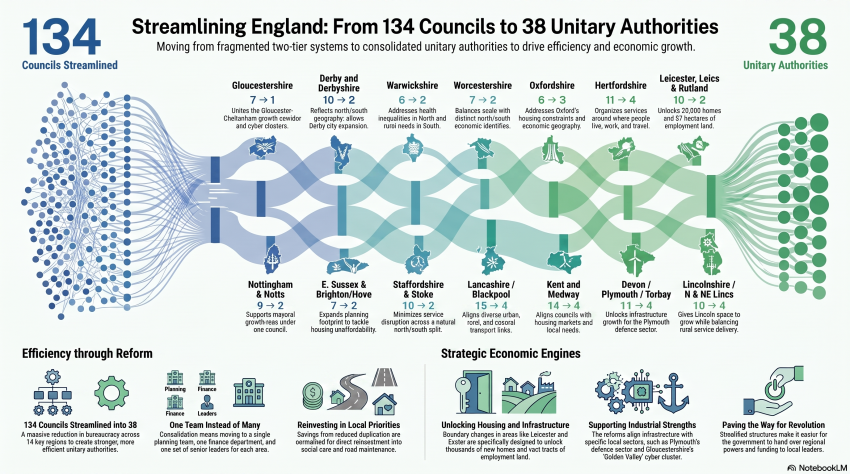
Local government reorganisation in 2026 is being presented as a decisive break with the county and district system created in 1974. Two tiers will become one. Duplication will be removed. Accountability will become clearer. Larger organisations will have the capacity and financial resilience to deliver better services. Strategic authorities and elected mayors will then address the issues that cross council boundaries, including transport, infrastructure, housing, skills and economic growth.
Much of that case may be reasonable. But it also sounds familiar. The 1974 reorganisation was justified by many of the same claims: existing councils were too fragmented, boundaries no longer reflected the way people lived and worked, some authorities were too small to sustain specialist services, and a more rational structure would be clearer and more efficient.
The central question is therefore not whether the new system is identical to 1974. It plainly is not. The more interesting question is whether England is once again reorganising the same basic tension between strategic capacity and genuinely local government.
What 1974 was trying to solve
Before 1974, local government was an untidy mixture of county councils, county boroughs, municipal boroughs, urban districts and rural districts. Some large towns and cities operated independently of their surrounding counties. Smaller authorities often covered areas that had been overtaken by population growth, commuting patterns and the expansion of public services.
The Local Government Act 1972 swept much of that structure away. From April 1974, most of England outside London was organised into counties and districts. Counties handled services that were thought to require scale, including education, social services, strategic planning, transport, fire and police. Districts were closer to individual towns and communities and dealt with functions such as housing, local planning, environmental health and refuse collection.
It was an attempt to preserve two things at once: organisations large enough to run complex services and councils local enough to retain civic identity and accessibility. It reduced more than 1,200 councils to fewer than 400 outside London, so even the supposedly local district tier often joined several long-established councils together.
Was it strongly opposed?
Yes, although the opposition was uneven. There was broad political agreement that the old arrangements needed reform. The fiercest arguments were about the model, the division of functions, the names and, above all, the boundaries.
County boroughs resented losing their independence. Historic counties objected to areas being transferred elsewhere. Ancient boroughs feared that centuries of civic tradition would disappear into newly invented councils. Other places argued that the new boundaries ignored transport links, employment patterns and the communities with which residents actually identified.
The parliamentary debates have a distinctly modern sound. MPs warned about remote government, larger bureaucracies and declining public interest. They questioned whether proper cost analyses had been undertaken. They worried about the disruption caused by breaking up experienced teams and transferring staff, assets and services. Ministers pointed to extensive consultation; opponents replied that consultation was rushed or that the central decisions had effectively already been made.
Some of the most controversial creations, including Avon, Cleveland and Humberside, lasted barely two decades. Rutland and Herefordshire eventually reappeared as administrative areas. The lesson is not that every 1974 boundary was wrong, but that administrative convenience does not necessarily extinguish historic identity or public attachment to place.
The arguments have returned
The complaints being made about the current programme follow much the same pattern. New unitary councils may be too large and remote. District and borough identities may be lost. Fewer councillors may mean larger wards, heavier workloads and less contact with residents. The cost of transition may arrive immediately while savings remain uncertain or take years to materialise.
There are also fears that reorganisation will distract senior officers from already fragile services. Adult social care, children’s services, SEND, temporary accommodation, council tax collection and financial recovery do not pause while organisations merge. Nor do difficult questions about debt, reserves, council tax harmonisation, service standards, staff structures, buildings, contracts and computer systems disappear merely because new boundaries have been agreed.
Those concerns are not confined to instinctive opponents of change. The Local Government Information Unit found in 2025 that only one in ten senior council respondents believed they had been adequately involved in the process. Only one in five thought the timetable was deliverable, and fewer than one in four believed reorganisation would improve council finances. As in the early 1970s, many people accept that change may be necessary but remain unconvinced by the proposed scale, process or timetable.
Not the same two-tier system, but still two levels
There is an important legal distinction. Local government reorganisation replaces county and district councils with unitary councils. Those unitary authorities will be responsible for the full range of principal council services. In that sense, two-tier local government really is being abolished.
Strategic authorities are formally part of a separate devolution programme. They are not county councils under another name, and they will not generally deliver the full range of services once undertaken by counties. Their role is centred on strategy, investment and programmes across wider areas, with responsibilities covering transport and infrastructure, skills, housing and strategic planning, economic development, the environment, public service reform and public safety.
Yet from the viewpoint of how England is governed territorially, a two-level structure is clearly emerging. The unitary council will deliver local government services. Above it, a strategic authority will make decisions across a wider area. Below it, parish councils, town councils, neighbourhood boards and local arrangements will be expected to preserve community voice.
We should therefore be precise. England is not recreating formal county and district government. It is replacing it with a functional strategic authority and unitary system. The tiers have changed their names, geography and responsibilities, but the need to govern at different scales has not disappeared.
The ghost of Redcliffe-Maud
In fact, the emerging structure may resemble the proposals that were rejected before 1974 more closely than the system that was eventually introduced.
The Redcliffe-Maud Commission proposed 58 large unitary authorities across most of England, together with eight provinces. Its proposals prompted a memorable campaign against remote government under the slogan ‘Don’t Vote for R. E. Mote’. The Conservative Government elected in 1970 rejected most of that model and opted for counties and districts instead.
The current direction of travel is towards large unitary councils, initially guided by an assumption of around 500,000 residents, grouped within strategic authorities whose default geography has been described as around 1.5 million people. With elected mayors and modern devolved powers, this is not Redcliffe-Maud revived word for word. But the family resemblance is difficult to miss.
A fair summary might be that 2026 is politically a replay of 1974, but structurally closer to a modern version of Redcliffe-Maud.
What history should teach us
The lesson of 1974 is not that local government should never be reorganised. Structures can become outdated, responsibilities can be needlessly fragmented and boundaries can cease to reflect real economic and social geography.
The lesson is that structural change does not, by itself, settle the relationship between efficiency and democracy. Larger councils may gain strategic capacity, purchasing power and specialist expertise, but they can also become harder for residents to understand and influence. Removing one set of organisational boundaries can simply create new boundaries and new areas of overlap.
If the new system is to avoid repeating the weaknesses of 1974, local identity and representation cannot be treated as matters to resolve after the map has been drawn. Area committees, local service hubs, meaningful parish and town council relationships, neighbourhood governance, sensible councillor numbers and clear routes for community influence must be designed into the new authorities from the beginning.
There must also be honesty about transition. Savings may be possible, but harmonising services, tax levels, policies, systems and organisational cultures is difficult and expensive. The test should not be whether a new council can produce an impressive business case. It should be whether residents receive better, more financially sustainable and more accountable services once the inevitable upheaval has passed.
History is not repeating itself exactly
The Government is abolishing the county and district structure created in 1974, but it is not abolishing the need for decisions to be made at different geographical levels. Counties and districts are giving way to strategic authorities and unitary councils. The legal architecture is different, but the governing dilemma is much the same.
The promises are familiar: clearer accountability, less duplication, greater resilience and better strategic leadership. So are the objections: remote institutions, weakened local identity, uncertain savings, disruptive transition and too little public influence over the final map.
History is therefore not repeating itself exactly. But it is asking us the same question again: how large can local government become before it ceases to feel local? The success of the present reorganisation will depend less on the elegance of the new map than on whether the new institutions can answer that question better than their predecessors.
Sources and further reading
• House of Commons Library, Long shadows: 50 years of the Local Government Act 1972
• House of Commons Hansard, Local Government Bill debate, 16 November 1971
• HM Government, English Devolution White Paper
• English Devolution and Community Empowerment Act 2026
• Local Government Association, Devolution and LGR FAQs
• Institute for Government, What is local government reorganisation?
• LGIU, State of Local Government Finance in England 2025
• Local Government Association, current LGR programme and milestones