


The Monday Discussion Group considers what a Burnham government might mean for local taxation, welfare delivery and local government reform
The prospect of an Andy Burnham-led government presents an intriguing question for local government: would a Prime Minister shaped by his experience as a mayor genuinely transfer power away from Whitehall, or would familiar ambitions once again be constrained by the Treasury, limited funding and central control?
That question formed the basis of a lively discussion by the Independent Revenues and Benefits Monday Discussion Group. Participants broadly welcomed greater recognition of local government’s capabilities, but they differed sharply over Burnham’s record, the merits of devolution and whether local authorities have the resources, structures and tax bases needed to exercise substantially greater powers.
A Prime Minister shaped by local government?
Opening the discussion, Malcolm Gardner asked whether Burnham’s experience in Greater Manchester should be regarded as a genuine advantage for the sector or merely “false comfort”.
Malcolm identified several themes emerging from Burnham’s developing political platform: a preventative state, greater spending on early intervention, the transfer of power and funding from Whitehall, and stronger local control over housing, employment, skills and transport.
He suggested that the idea sometimes described as “Manchesterism” offered at least the outline of a different operating model for government. However, he also cautioned that the proposals were not yet fully costed and would remain constrained by existing fiscal rules.
For Malcolm, the crucial issue was the gap between political doctrine and available budgets. Revenues and Benefits services frequently operate within that gap, implementing national ambitions while managing the practical and financial consequences locally.
Paul Howarth was among the most positive contributors. He believed that a Prime Minister with substantial local government experience could provide a clearer sense of direction, particularly if devolution became a central part of the programme.
Paul saw Burnham’s apparent desire to connect local economic development with social improvement as potentially significant. However, he argued that meaningful devolution would eventually require local taxation powers as well as control over spending.
Without the ability to raise revenue, local areas would continue to depend on Treasury decisions. The logical conclusion of Burnham’s position, Paul suggested, was therefore not simply more devolved expenditure but greater local fiscal autonomy.
He was also unconcerned by warnings about a “postcode lottery”, describing the phrase as overused. Different local choices would inevitably produce different results. The more important question was whether areas had the resources and powers needed to make those choices fairly.
Caution about the Burnham record
Rachael Walker was more guarded. While acknowledging the success and profile of the Greater Manchester Combined Authority, she argued that Burnham should ultimately be judged by how he treated local government finance.
She observed that Burnham had served in central government before becoming a mayor and suggested that local government may have “made him cool” rather than fundamentally forged his political outlook.
For Rachael, the decisive test would be whether a Burnham government addressed the deep inequalities in local tax bases. Devolving responsibilities without correcting those inequalities could intensify rather than resolve geographic injustice.
Peter Haywood was considerably more sceptical. He rejected the “King of the North” image and questioned how much of Greater Manchester’s progress could personally be attributed to Burnham.
In Peter’s assessment, important developments in Manchester, including aspects of its transport and growth agenda, had been initiated by earlier local leaders or depended heavily on central government support. He also pointed to the abandoned clean air charging proposals as an example of a major policy that had incurred substantial expenditure without being implemented.
His broader challenge was evidential: does devolution actually produce economic growth?
Peter questioned whether the experience of Scotland and Wales demonstrated that transferring powers necessarily improved economic or public service outcomes. He argued that Burnham’s precise political and economic position remained difficult to identify and that personal relatability should not be confused with the qualities required of a successful Prime Minister.
Tom Clark agreed that personal warmth was not enough. Having met Burnham and Liverpool City Region Mayor Steve Rotheram, Tom described both as personable figures, but said that being a “nice bloke” did not automatically translate into effective national leadership.
Prevention or another route to welfare cuts?
The discussion became sharper when it turned to welfare.
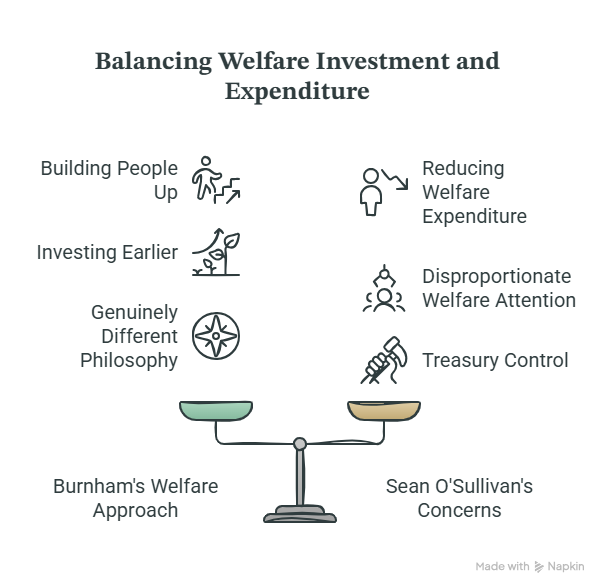
Burnham’s language about building people up, investing earlier and reducing future welfare expenditure sounded familiar to Sean O’Sullivan. He compared it to previous “make work pay” agendas and questioned whether it represented a genuinely different philosophy or another attempt to reduce support for working-age people.
Sean argued that working-age welfare had already borne a disproportionate share of political attention, while governments remained reluctant to confront spending on pensions. He was concerned that language about prevention could conceal a continuing commitment to reducing welfare expenditure.
He also warned that even well-intentioned reforms could be fundamentally altered by the Treasury. In his view, earlier welfare reform ambitions associated with figures such as Frank Field and Iain Duncan Smith had been weakened once financial control took precedence over policy design.
Malcolm agreed that the idea of early intervention had a long history. He linked Burnham’s position to work associated with Alan Milburn but noted that similar arguments had been made by previous reformers.
The question was therefore not whether prevention was desirable, but whether sufficient investment would be provided at the beginning and whether local services would be properly funded to deliver it.
Could welfare responsibilities return to councils?
Lynne McMorris identified a potentially important implication of Burnham’s argument that housing and skills were inherently local.
She recalled that, during earlier debates about Universal Credit, many practitioners argued that housing costs were too closely connected to local markets and local services to be administered effectively through a single centralised system.
If Burnham genuinely regarded housing as a local responsibility, Lynne suggested, that could eventually reopen the question of whether some housing-related welfare functions should return to councils.
Paul agreed that greater localisation could bring previously centralised responsibilities back into local government. But he also emphasised that this would require a determined effort to loosen Treasury control.
The warning from Council Tax Reduction
Rachael used Council Tax Reduction as a warning against badly designed localisation.
She drew a distinction between local decision-making, which she supported, and the localisation of welfare policy, which she believed had often been damaging.
In her view, local Council Tax Reduction had produced geographic injustice because councils were expected to design schemes from very different financial starting points. Areas with greater deprivation frequently had weaker tax bases, higher demand for support and lower collection rates.
Without effective equalisation, giving every council the same formal freedom did not create meaningful equality.
Rachael described the position through a football analogy. Asking a small or economically disadvantaged council to compete with a wealthy authority was like expecting Accrington Stanley to compete with Manchester United simply because both were football clubs. They did not have the same income, supporter base or purchasing power.
Malcolm argued that Council Tax Reduction had been only a partial form of localisation. Councils inherited responsibility alongside an initial funding reduction, while pension-age support remained nationally prescribed. Local schemes therefore had to work around a substantial protected element over which councils had no control.
In his assessment, Council Tax Reduction had effectively been “set up to fail”.
Rachael agreed, adding that council tax itself had been allowed to become increasingly important to local government finance despite its weaknesses and regressive structure. The result was a system in which the authorities facing the greatest need were often least able to raise the money required to meet it.
Sean added that local authorities were being asked to make economic and welfare policy without the analytical resources available to central government departments. Councils generally did not have large teams of economists, yet were expected to understand local labour markets, behavioural incentives, collection effects and welfare consequences.
Revenues and Benefits as the delivery arm
A central question emerged: if welfare policy shifted from managing dependency to preventing hardship and supporting employment, would Revenues and Benefits become the local delivery arm?
Michael Fisher offered a deliberately practical response. With a software replacement and the Crisis Resilience Fund already demanding attention, he said services still had to deal with what was directly in front of them.
His concern illustrated a wider operational risk. Even potentially positive reforms can become unmanageable when introduced alongside system changes, annual billing, recovery activity and existing service pressures. Michael was relieved to be undertaking his software migration before further major changes potentially arrived.
Laura Bessell was more forthright. Her cynical expectation was that anything politically difficult or operationally awkward would eventually be transferred to councils.
However, she also saw this as an acknowledgement of local government’s competence. Councils were repeatedly given difficult responsibilities because, despite limited resources, they generally found a way to deliver.
Laura did not believe Housing Benefit was approaching a genuine end. Whenever central government encountered complex areas such as supported accommodation or difficult individual cases, responsibility tended to remain with, or return to, local authorities.
She described local Council Tax Reduction as a “dog’s dinner”, not because officers lacked commitment, but because political requirements, software limitations and implementation timetables were often fundamentally misaligned.
Policy must come before technology
Laura and Malcolm agreed that future reform had to begin with policy rather than IT.
Malcolm argued that too many public service reforms had been designed around what a computer system could deliver, rather than simplifying legislation and policy first. Even when councils adopted “lean” working methods, the underlying rules and statutory structures often remained untouched.
Universal Credit, he suggested, was another example of excessive attention being given to the delivery system rather than the design and simplicity of the policy.
Laura also warned against replacing professional knowledge with excessive dependence on technology and artificial intelligence. Officers needed to retain the ability to understand calculations, identify errors and work manually when systems failed.
Her test for reform was straightforward: what is the policy trying to achieve, and what can realistically be delivered?
Does bigger mean better?
The discussion then turned to local government reorganisation.
Tom argued that many of the strongest local welfare services were found in larger unitary authorities, metropolitan councils and London boroughs. In his experience, a well-resourced unitary model could bring Revenues and Benefits, housing, adult social care and other services into a wider support system.
Local government reorganisation therefore offered significant opportunities, not just risks. Larger organisations could potentially combine data, professional expertise and financial resources in ways unavailable to smaller districts.
Laura responded that size alone did not remove pressure. Smaller authorities often lacked enough staff even to release officers for free professional events or training.
Tom nevertheless maintained that the broader ecosystem available within a large unitary authority made it better suited to delivering a modern welfare function than a small district council.
Rachael characterised this as a “Goldilocks” problem. District councils might be too small, while national government was too remote. Regions or substantial unitary authorities might represent the scale at which services, economic development and local accountability could be brought together.
But regionalisation would not automatically eliminate inequality. The North East, North West, South West and London had profoundly different economies, levels of poverty and labour markets.
The problem of council silos
Sean cautioned that larger councils did not necessarily produce integrated services.
He described authorities in which Revenues and Benefits, housing, social care and education each operated separate hardship funds. Poor communication meant residents could be assessed several times, departments pursued different objectives and some people learned to access several schemes while others received nothing.
Tom regarded this as a leadership failure rather than an unavoidable consequence of organisational size. Directors should ensure that departments shared information and worked towards common outcomes.
Both agreed that data protection was too often used as an excuse for inaction.
Lynne said successful data sharing depended on strong information governance and properly completed data protection impact assessments. Considerable amounts of useful information could now be shared lawfully, but councils needed staff with the knowledge and confidence to construct the correct arrangements.
Malcolm agreed that misunderstanding of data law remained widespread. The barriers were frequently managerial and cultural rather than legal.
Co-location works, but jobs still have to exist
Michael supported closer integration between benefits services and employment support. From his experience, co-locating Jobcentre and council teams created a more coherent service for residents.
Paul pointed to councils that had already used DWP and HMRC information to support residents into employment. He believed local government should have more confidence in its own abilities. During his time working on Housing Benefit policy, councils had often delivered initiatives that would have been difficult to achieve within the DWP.
Local government’s advantage, he argued, was its nimbleness.
Rachael agreed that a “no wrong door” approach could work well at the front desk. But she warned against confusing good administration with economic transformation.
A council could provide excellent advice, integrate services and support a young person effectively, but it could not create a suitable career where no local industry or employment pathway existed.
Without broader economic powers, local authorities could improve access to support but remained limited in their ability to change the underlying health of their economies or prevent the loss of young people and skilled workers to more prosperous areas.
Redistribution will produce winners and losers
Sean’s final warning concerned the effect of redistributing institutions, investment and public employment away from London.
Moving high-paid jobs could stimulate regional economies, but it could also inflate local housing markets and displace existing residents. He cited the relocation of major public bodies as an example of how incoming workers with London property wealth could transform prices in receiving areas.
Malcolm accepted that rebalancing would create winners and losers. Similar changes could be seen in parts of Edinburgh following devolution and the expansion of the Scottish Government.
The political question was whether those disruptions were an unacceptable cost or part of a necessary rebalancing of the country.
Kirsty Brooksmith, invited to give the final view, remained firmly unconvinced. Despite being a northerner, she said she did not support Burnham’s policies or vision and feared that London boroughs would suffer significantly.
She was also concerned about the consequences for younger people living in the South.
Her final observation brought the discussion back to operational reality: whatever political settlement emerged, its practical consequences would probably land on Revenues and Benefits.
As Laura had said earlier, they usually do.
The unresolved questions
The discussion did not produce a consensus on Burnham, devolution or the ideal scale of government. It did, however, expose several tests that any serious programme of reform would need to meet.
Devolution would have to include genuine financial powers, not simply the transfer of responsibilities. Differences in tax bases would require strong equalisation if local choice was not to become geographic injustice. Policy would need to be simplified before new technology was commissioned. Data sharing would require leadership and sound governance. Most importantly, Revenues and Benefits services would need funding and capacity proportionate to the responsibilities placed upon them.
The group did not reach its planned debate about whether council tax itself was politically finished, or whether it should eventually be replaced by revaluation, proportional property taxation or a land-value-based system. That discussion was left for another Monday.