

Independent Revenues and Benefits Monday Discussion Group | 26 October 2026
Council tax collection remains remarkably high, yet arrears continue to rise, households are struggling and councils are under increasing financial pressure. Is the problem poor collection, the way we measure performance, or a local taxation system that has simply passed its sell-by date? Our Monday Discussion Group had plenty to say, and not everyone agreed.
The Recording can be found here
A 95.6% Collection Rate. Should We Be Celebrating?
I opened Monday’s discussion with a statistic that, in almost any other industry, would be regarded as an outstanding achievement.
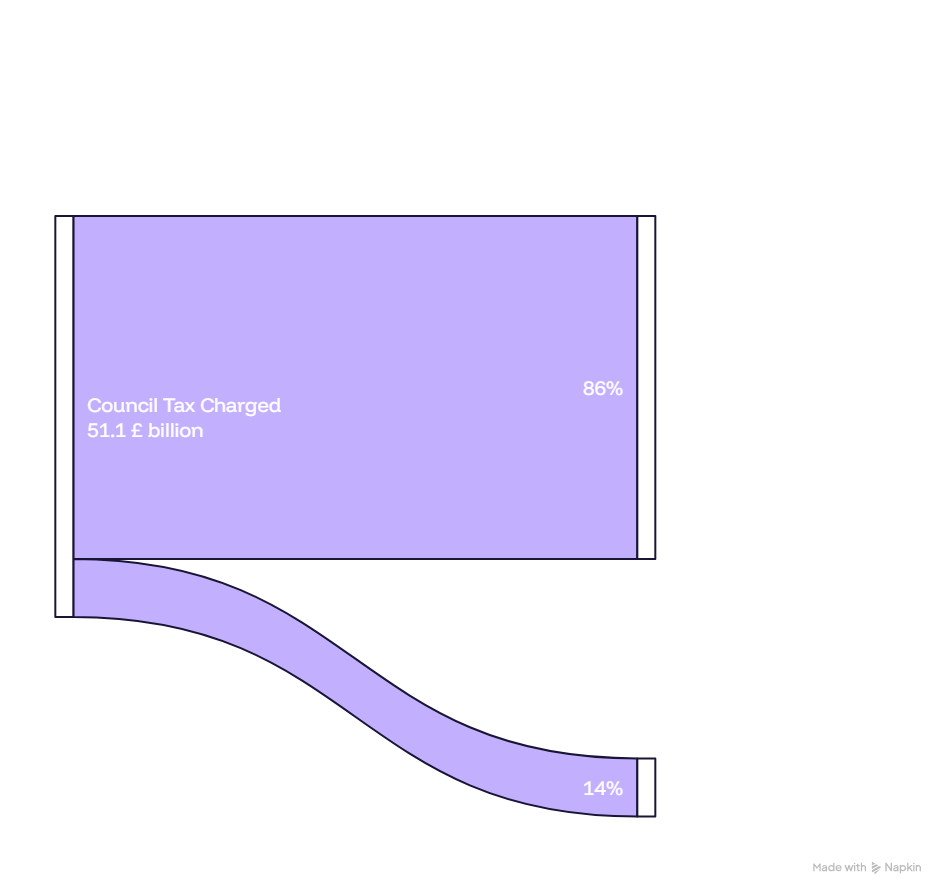
England’s in-year council tax collection rate for 2025/26 was 95.6%. We collected approximately £43.7 billion. Shire districts achieved around 97%, while London boroughs were closer to 94%.
Yet we also have some £7.4 billion in outstanding council tax arrears.
That raises a rather uncomfortable question. Are we measuring success, or are we simply getting better at disguising a problem that is steadily becoming worse?
A collection rate of 95.6% sounds impressive. But when the amount being charged increases year after year, the remaining percentage represents an increasingly substantial sum of money. It also represents households, many of which are struggling to meet their liabilities.
As I suggested to the group, the issue is not that council tax collection has collapsed. It hasn’t. The issue is the direction of travel and what lies behind the headline numbers.
What followed was a fascinating discussion that took us from performance indicators and management behaviour to poverty, local democracy, the future of taxation and what we might reasonably expect from the Budget.
And, as usual, we didn’t always agree.
The Arrears Problem: Are We Looking at the Wrong Number?
Ian Savigar opened the discussion with a practitioner’s perspective. Having worked across several authorities, Ian acknowledged that collection rates have been gradually declining, although the picture varies considerably between councils.
His greater concern was the growing stock of older debt.
Councils are struggling with resources, and the work required to investigate, reconcile and resolve historic arrears is often pushed to the back of the queue.
Some debts have been sitting on accounts for years. They may have been referred to enforcement agents, but the council has not necessarily reconciled its records with those held by the agents.
Meanwhile, bad debt provisions and potential write-offs continue to grow.
Ian also highlighted a particularly worrying consequence of changes to Council Tax Reduction schemes. As authorities seek to contain expenditure, some have increased the minimum contribution required from low-income households.
The result can be large numbers of relatively small debts, often involving households with very limited capacity to pay.
Are we actually improving council finances, or simply manufacturing more debt?
Peter Haywood challenged us to think more carefully about the relationship between collection, arrears and write-offs.
He described a practical approach he had used when managing arrears, the 10, 20, 30 rule. In broad terms, this involved writing off 10% of outstanding debt, collecting 20% and recognising that new arrears would replenish the balance.
His wider point was that the relationship between bad debt provisions, actual write-offs and arrears collection needs much closer examination.
Nationally, council tax write-offs were around £305 million in 2025/26, according to the figures discussed. This is a relatively modest amount compared with the total stock of outstanding arrears.
Peter questioned whether councils are making realistic decisions about debts that are no longer recoverable.
A bad debt provision is an accounting recognition that some money is unlikely to be collected. It is not itself a write-off. But if councils continually provide for doubtful debts while retaining increasingly unrealistic arrears on their books, the problem becomes progressively more difficult to manage.
Peter’s argument was not that councils should simply abandon collection. Quite the opposite. They should recognise irrecoverable debt, concentrate resources on liabilities that can realistically be collected and stop allowing old balances to distort the picture.
Robert Fox agreed, observing that arrears collection is increasingly important to authorities trying to balance their budgets.
But he also described a familiar dilemma. Getting approval to write off irrecoverable debt can be difficult, while obtaining agreement for more robust recovery action can be equally challenging.
Councils can find themselves caught between competing expectations.
Robert argued that the changing recovery framework makes prevention and early intervention more important than ever. Councils need to identify problems sooner and engage with households before formal recovery becomes necessary.
That seems an entirely sensible proposition.
But why, when we know this, do we continue to devote so much attention to what happens after the debt has already arisen?
The £30,000 Saving That Could Cost £1 Million
One of the strongest contributions came from Michael Fisher, who challenged the wisdom of recruitment freezes and reductions in revenues staffing.
His point was simple.
If somebody moves into a property and the council doesn’t issue a bill, the resident cannot reasonably be expected to pay it.
And if somebody moves out but the change has not been processed, the council may continue pursuing the wrong person while failing to bill the new liable resident.
Michael described how backlogs in processing changes of address can create substantial liabilities that remain unbilled.
He gave an illustrative example of a council seeking to save approximately £30,000 by leaving an assessment post vacant. If that employee would otherwise have processed hundreds of changes, the resulting delays could affect charges worth hundreds of thousands of pounds, potentially approaching £1 million.
Not all that money would necessarily be lost, of course. But delayed billing makes collection harder and creates avoidable problems for residents.
Imagine receiving a bill for nine months of council tax, with only six months left in which to pay it.
The council has created a payment difficulty through its own administrative delay.
Ian reinforced the argument with an example of a substantial change-of-address backlog affecting approximately £3 million in liabilities.
This is precisely the sort of issue we discussed the previous week when considering what constitutes a smart saving.
Reducing staffing expenditure can look attractive in a budget report. But if the saving delays billing, increases arrears, damages collection and generates further recovery costs, what exactly have we saved?
We need to stop treating the cost of administering council tax as entirely separate from the income it generates.
Sometimes spending more on administration is the most financially responsible thing a council can do.
What Gets Measured Gets Done. But What If We Measure the Wrong Thing?
This brought us to one of the most contentious subjects of the meeting.
Sean O’Sullivan argued that the emphasis on in-year collection percentages can create perverse incentives.
When councils are measured primarily on the percentage of debit collected, issuing additional bills late in the financial year increases the amount owed without giving residents much time to pay.
In certain circumstances, Sean suggested, this has encouraged authorities to defer processing changes until the following financial year.
The reported percentage may look better, but the underlying position has not improved.
Worse still, the household eventually receives a larger bill.
Sean advocated a return to greater emphasis on budgeted yield, measuring the money actually collected against the income expected.
Ian recalled that councils once reported collection above 100% of budgeted yield, something that eventually became politically and presentationally uncomfortable.
But perhaps we lost something valuable when we moved away from that approach.
Bob Wagstaff recalled a mission statement he developed when leading a council tax team. Its purpose was to bill residents promptly, accurately and only once, while making payment as straightforward as possible.
It sounds obvious, doesn’t it?
Yet if the performance framework rewards a council for delaying a bill, we have managed to create an incentive that directly contradicts that basic service objective.
However, there was an important challenge to the suggestion that such practices were widespread.
Peter said that across the four councils where he had worked, he had never encountered a deliberate decision to stop council tax billing in March. Julie Smethurst similarly emphasised that this was not standard practice in her experience.
Additional contributions in the meeting chat reinforced this distinction. Several experienced practitioners said that they had not encountered deliberate year-end billing freezes for many years, if ever. Others recalled examples from the early 2000s, while recognising that prioritising particular categories of work is not the same as stopping billing.
There was also recognition of a legitimate distinction involving business rates and Valuation Office Agency schedules. A very large assessment received in the final days of March, with insufficient time to establish a meaningful instalment arrangement, can present a genuine operational dilemma.
The arrival of new valuation lists prompted the wonderfully understated chat reaction, “Shock horror new VO lists!”
The point is that we should not confuse historical anecdotes, isolated practices and legitimate operational decisions with evidence of widespread manipulation.
Mark Stewart took a similar line. He suggested that the emphasis in many authorities has moved away from collection-rate league tables towards income maximisation, particularly since the pandemic and the growing pressure on council budgets.
He also pointed out that the consequences of delayed billing eventually appear elsewhere in the figures, particularly in outstanding arrears.
Mark argued for stronger guidance and a better understanding of what good performance actually means.
Rachael Walker, however, was less convinced that the underlying culture had changed. She spoke about the intense pressure on revenues managers to deliver year-end collection targets and the risk of operational decisions being driven by those targets.
The meeting chat offered a useful reminder that some authorities still report just two headline internal indicators for revenues: council tax collection and business rates collection.
These remain important measures. Nobody suggested abandoning them.
But perhaps we should be measuring a wider set of outcomes alongside them.
How quickly are bills issued? How much debt is carried forward? How much is genuinely recoverable? How much is written off? How many households move into repeated recovery? And how much does it cost to collect each additional pound?
What gets measured gets done.
The question is whether we are measuring what matters.
Are We Creating the Debt We Are Trying to Collect?
Rachael Walker was characteristically direct.
Her argument was that council tax is fundamentally the wrong tax, collected from the wrong people in the wrong way, and that the problems cannot be resolved through administrative improvements alone.
She questioned the almost exclusive focus on in-year collection performance.
A council can collect more cash than it did the previous year while simultaneously adding to the debt carried by its residents.
Those two things are not contradictory.
Rachael also highlighted the relationship between deprivation and collection performance. Authorities serving more deprived communities face greater collection challenges than those with more affluent populations.
That helps explain why comparing collection rates across councils can be misleading.
A shire district achieving 97% and an urban authority achieving 93% are not necessarily demonstrating different levels of managerial competence. They may be operating in very different economic circumstances.
Rachael also argued that reducing Council Tax Reduction can increase the number of households entering recovery, particularly where previously fully protected residents are required to make contributions.
I think there is a bigger issue here.
We are increasingly asking local taxation to do two jobs that may be incompatible.
We want it to generate more revenue for local services, and we want it to remain affordable for households whose incomes have not kept pace with the demands being placed upon them.
Council Tax Reduction is intended to help bridge that gap. But if councils are financially incentivised to reduce support, we risk transferring pressures from the council’s budget to the household’s budget.
And that household may already be at its tipping point.
A Tax That Has Grown Beyond Its Original Purpose
Bob Wagstaff reminded us that council tax was introduced as a replacement for the Community Charge, rather than as the product of a comprehensive redesign of local government finance.
Over the years, successive increases have made council tax a much more significant part of household expenditure.
Sean O’Sullivan added that council tax was originally expected to fund a much smaller proportion of local government spending, alongside government grant and business rates.
As the balance of funding has changed, the demands placed upon local taxation have grown.
This creates a fundamental problem.
The ability of councils to raise revenue from their local tax base does not necessarily correspond to the needs of the communities they serve.
And as council tax increases, the affordability problem becomes more pronounced.
Michael Fisher illustrated the cumulative effect of household bills increasing faster than wages.
Even relatively modest annual differences compound over time. If a household’s council tax rises by 5% a year while its income rises by 3%, the proportion of its income required to pay council tax will steadily increase.
It is not difficult to see where that leads.
I also reminded the group that some authorities in the north of England experienced successive increases of around 20% in the early 2000s.
The present pressures did not emerge overnight.
Yet despite the substantial increases in council tax over recent years, many councils still argue that they cannot fund the level of services expected of them.
We are asking households to pay more for a system that councils themselves regard as inadequately funded.
There is something rather fundamentally wrong with that proposition.

Should We Have a Local Tax at All?
At this point, the discussion took a more philosophical turn.
Gareth Morgan posed what I thought was one of the most important questions of the morning.
Why do we need a local tax?
We need services delivered locally, certainly. But why must the money to pay for those services necessarily be raised locally?
Two households with similar financial circumstances can face significantly different council tax bills depending on where they live.
The location of a household does not necessarily tell us anything meaningful about its ability to contribute.
Gareth questioned whether we have simply accepted local taxation because it is the system we have inherited.
Rachael strongly agreed.
She argued that our economies no longer operate within neat geographical boundaries. People work, shop and consume services across local, national and international markets.
Yet we continue to rely upon locally raised taxation to fund services that are increasingly driven by national policy and wider economic pressures.
Her comparison was with the NHS.
We do not require individual hospitals to levy local taxes to fund their services. National taxation supports a system in which resources are distributed according to funding arrangements and assessed needs.
Why should local government be fundamentally different?
I pushed back a little.
Local taxation has a long history, and there is an important relationship between local services, local democracy and the communities they serve.
People may not analyse the technicalities of local government finance, but they certainly understand that their council tax is connected with local services.
Does removing that connection risk weakening local accountability?
Rachael’s response was that accountability should be about outcomes rather than the ability to raise money.
We should judge councils by the quality of services, improvements in people’s lives, educational opportunities, cleaner streets and better communities.
That is an important challenge.
Julie Smethurst added a more cynical interpretation, suggesting that local taxation can also provide central government with a convenient way of deflecting responsibility for difficult funding decisions.
If councils are required to raise unpopular taxes to fund services whose costs and duties are largely determined nationally, who takes the political blame?
Sean O’Sullivan and Robert Fox, however, defended the connection between taxation and place.
Sean argued that local taxation helps preserve the relationship between residents and local democratic institutions, including parish and town councils.
Robert expressed concern about the potential loss of that connection as local government reorganisation creates much larger authorities.
He referred to Surrey, where the move from eleven district and borough councils to two new unitary authorities raises questions about how residents will continue to identify with local service delivery.
It was an interesting disagreement.
I suspect the answer lies somewhere between the two positions.
We need national funding arrangements that recognise differences in need and capacity. But we also need local democratic institutions that remain accountable and relevant to the communities they serve.
Perhaps the real question is not whether local taxation should exist, but what it should reasonably be expected to fund.
Council Tax Reform: Everyone Knows the Problem, So Why Don’t We Fix It?
There was considerable agreement that the existing system is increasingly difficult to defend.
But there was much less optimism about whether government would do anything fundamental about it.
Paul Howarth observed that a headline collection rate of 95.6% does little to persuade ministers that there is an urgent problem.
From the perspective of central government, the system may appear to be working.
The difficulties are hidden beneath the national statistics.
Paul also reflected on his experience at the Department for Work and Pensions, where structured engagement with local authorities provided opportunities to challenge policy and identify practical problems.
He questioned whether similarly effective channels exist between revenues professionals and the department responsible for local government.
The profession understands many of the difficulties. But is anybody listening?
Mark Stewart was equally sceptical about significant reform, although for slightly different reasons.
He pointed to the succession of consultations on council tax and business rates that have produced relatively modest changes rather than a fundamental redesign.
His expectation was that the system would continue to be adjusted around the edges rather than replaced.
Rachael raised the distribution of property wealth and the failure to undertake regular council tax revaluations.
Properties remain assessed against values dating from 1991 in England, while the distribution of property wealth has changed enormously.
Reform would inevitably raise difficult questions about who should pay more and who should pay less.
And that, perhaps, is why successive governments have preferred to leave the issue alone.
It is politically easier to adjust an imperfect system than to confront the consequences of replacing it.
But there is a cost to doing nothing.
Every year that passes creates another layer of complexity, another set of exemptions and adjustments, and another round of pressures on councils and households.
What Would We Like to See in the Budget?
Towards the end of the meeting, I asked everyone to identify three things they would like to see in the Budget, thinking about households, local authorities and the wider system.
The responses were revealing because, despite disagreements about council tax, there was considerable common ground about the pressures facing public services.
Rachael Walker wanted a fundamental change in the funding of social care, greater financial support for temporary and supported accommodation, and ultimately the replacement of council tax. She also speculated that government might move towards more nationally funded social care, although that was a prediction rather than an announced policy.
Kirsty Brooksmith focused on the pressures of social care costs for households and the growing resource demands placed upon local authorities. She particularly wanted investment to help councils respond to artificial intelligence, both through workforce capacity and the practical adoption of new technology.
Her argument was that AI represents an opportunity, but also another major responsibility being placed upon already stretched services.
Gareth Morgan called for Local Housing Allowance rates to be unfrozen and for the benefit cap to be reviewed or substantially increased.
His point was that increasing benefit entitlements can achieve very little for a household already caught by the cap.
He subsequently added a call for a national Council Tax Reduction scheme in England.
That would address one of the most troubling features of the current arrangements: households in similar circumstances receiving different levels of support simply because they live in different council areas.
Bob Wagstaff supported reform of the benefit cap, LHA and council tax. He also made a spirited case for reducing the taxation pressures facing pubs and breweries.
There are, apparently, some local services that the group regards as particularly important to preserve.
Robert Fox focused on the financial pressures of temporary accommodation and homelessness, including the gap between the costs councils incur and the funding they receive.
The pressure is not simply financial. Councils continue to face the human consequences of homelessness while struggling to fund the accommodation required.
Paul Howarth anticipated a relatively modest Budget and suggested that increases in tax-free allowances could offer some relief to households.
He also challenged government to apply its ambitions for reducing red tape to local authorities, rather than concentrating solely on business regulation.
Paul was particularly concerned about the failure to maintain LHA as originally intended.
The meeting chat added several further proposals.
There was support for a welfare system that protects those who cannot work, supports those who can and ensures that employment provides a clear financial advantage over remaining on benefits.
Others reinforced the call for nationally funded social care, full reimbursement of appropriate temporary accommodation costs and a return to a centrally funded Council Tax Benefit-style scheme.
There was even a suggestion that Freedom of Information requirements should be reviewed, with one contributor proposing a substantial reduction in the staff time authorities are expected to devote to individual requests.
That last proposal would certainly provoke a debate of its own. Transparency and administrative burden are both legitimate considerations, although reducing access to public information would have consequences for accountability.
Taken together, the suggestions demonstrated something important.
The challenges facing revenues and benefits services cannot be separated from the wider funding and welfare systems.
We cannot solve council tax collection simply by changing recovery procedures if the underlying problem is that increasing numbers of households cannot afford what they are being asked to pay.
Are We Collecting Debt or Creating It?
I came away from the discussion with several thoughts.
First, a high collection rate is not the same thing as a healthy collection system.
Second, performance indicators matter, but poorly designed indicators can encourage precisely the behaviours we ought to be discouraging.
Third, resources matter. We cannot repeatedly reduce the capacity of revenues teams, allow backlogs to develop and then express surprise when collection becomes more difficult.
Fourth, we need to take a much more intelligent approach to debt. That means distinguishing between those who can pay, those who need help to pay and those whose circumstances make the debt genuinely unrecoverable.
And finally, we need to confront the much bigger question of whether council tax remains a fair and sustainable means of financing local services.
I am not entirely persuaded that abolishing local taxation is the answer. I remain concerned about the relationship between local democracy, local accountability and locally delivered services.
But I am persuaded that the present arrangements are under increasing strain.
We have a tax based on property values from more than three decades ago, levied upon households with vastly different financial circumstances, supported by reduction schemes that vary between authorities, and expected to contribute ever more towards the cost of essential public services.
Meanwhile, we measure performance primarily through the proportion of money collected during a particular twelve-month period.
Perhaps we should be asking a different question.
Not simply how much council tax have we collected, but how effectively have we managed the liability, supported the household and protected the financial interests of the community?
Those are not necessarily conflicting objectives.
Indeed, I would argue that the best-performing revenues services increasingly need to understand the connections between them.
Because the real success of a council tax system should not be measured solely by how efficiently we collect the money.
It should also be measured by how little avoidable debt we create in the process.
And perhaps that is where the next generation of performance indicators should begin.
The Recording can be found here
This article is based on the Independent Revenues and Benefits Monday Discussion Group held on 26 October 2026. Contributions have been edited and brought together into a narrative while preserving the substance of the speakers’ arguments. Additional points from the meeting chat have been incorporated. The views expressed are those of individual contributors and do not necessarily represent the positions of their employers or organisations.
Speakers and contributors: Malcolm Gardner (Chair), Ian Savigar, Peter Haywood, Robert Fox, Michael Fisher, Rachael Walker, Sean O’Sullivan, Bob Wagstaff, Mark Stewart, Paul Howarth, Gareth Morgan, Julie Smethurst and Kirsty Brooksmith.