
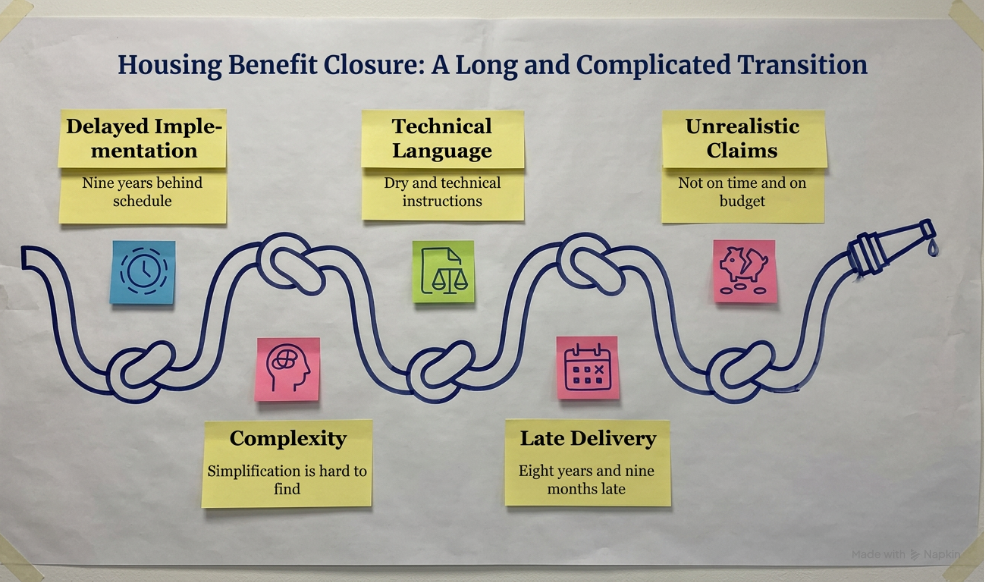
The ordinary working age Housing Benefit caseload has finally closed, almost nine years after Universal Credit was supposed to have completed the job. The administrative milestone is real. The promised simplification is much harder to find.
On 1 July 2026, one of the longest running chapters in British social security policy formally came to an end. From that date, working age people could no longer remain on Housing Benefit unless they were living in temporary or specified accommodation, or fell within a narrow group of exceptions. Most working age help with rent now sits inside Universal Credit.
The language of the Department for Work and Pensions’ A6/2026 circular is dry and technical. It instructs councils to check that every remaining working age award is lawful and explains the residual routes by which a Housing Benefit claim may continue or, in a few cases, be made again. Read as a piece of administrative history, however, it is remarkable. This circular closes a transfer that was originally meant to be completed in October 2017.
That makes the final legal closure roughly eight years and nine months late. It arrives more than fifteen years after Universal Credit was announced. No reasonable reading of that history can sustain the early claim that the programme was being delivered “on time and on budget”.
The promise and the project
Universal Credit began with a compelling proposition. The 2010 White Paper, Universal Credit: welfare that works, promised to bring six working age benefits and tax credits into one system. It would be easier to understand, make work pay, reduce fraud and error, and cut administration. A single monthly payment would resemble a wage. Claimants would take responsibility for household bills, including rent, in much the same way as people in employment.
In September 2012, with implementation due to begin the following year, the then Secretary of State, Iain Duncan Smith, told Parliament that Universal Credit was “on time and on budget”. The planned timetable was straightforward: national implementation from October 2013, with the existing caseload transferred by October 2017.
The reality was a succession of resets, revised business cases, new delivery systems and postponed completion dates. The National Audit Office recorded that the programme’s estimated investment cost rose from £2.016 billion in the 2018 business case to £2.928 billion in DWP’s 2023 estimate, an increase of £912 million, or 45 per cent. Even that figure excluded the cost of moving many Employment and Support Allowance claimants, because at that point their migration had been pushed beyond the formal programme timetable. The NAO’s 2024 report also set out the repeated changes in completion date, from October 2017, to March 2022, and then beyond.
DWP’s February 2026 statistics described the plan for all remaining legacy claimants to have migrated by March 2026. The July circular reveals the important distinction between an operational migration target and legal reality. Ordinary working age Housing Benefit did not finally close until 1 July, and even then Housing Benefit itself did not disappear.
This was not merely a large project that encountered a few unforeseeable difficulties. Complexity was designed out of the presentation long before it was designed out of the system. Ministers described one benefit and one payment. Delivery required two incompatible computer systems, extensive manual work, repeated transitional protections, managed migration notices, run ons, alternative payment arrangements and continuing local administration for the cases that did not fit the model.
The fairest verdict is that Universal Credit eventually achieved broad coverage, but only after the timetable and cost promises that accompanied it had ceased to have much meaning.
Closure does not mean abolition
The residual Housing Benefit caseload is not a trivial footnote. Pension age claimants remain within Housing Benefit, including some mixed age couples protected by transitional rules. Working age people in temporary accommodation and specified accommodation generally continue to receive Universal Credit for living costs and Housing Benefit for rent. A person who leaves such accommodation may move to the Universal Credit housing element, then return to Housing Benefit if they move back into qualifying accommodation.
The A6 circular also preserves tightly drawn exceptions. They include the two week Housing Benefit run on when a claimant moves to Universal Credit, certain income related Employment and Support Allowance cases where an appointee is in place or required, and some people in prison, on remand or in hospital pending their release. Councils must retain enough expertise to identify these cases, process changes, recover overpayments, deal with subsidy and adjudicate claims correctly.
At November 2025, immediately before the last phase of closure, there were still about 1.5 million Housing Benefit claims. Around 1.1 million were from pension age claimants and 370,000 from working age claimants. The figures are not a forecast of the post July residual caseload, but they show why “Housing Benefit has ended” would be wrong. Most of the scheme was already a pension age service before ordinary working age entitlement closed.
In other words, the simple, high volume part of working age Housing Benefit has moved to DWP. Councils are left with a smaller caseload containing some of the most legally and operationally difficult housing in the system.
Specified accommodation is a good example. Entitlement can turn on the landlord’s legal status, the way the scheme is managed and whether more than minimal care, support or supervision is provided. That language has generated case law, inconsistent interpretation and a market in which high rents may fall outside the normal benefit caps. In its 2023 investigation into supported housing, the NAO found that government lacked reliable national data on the sector. It reported an estimated £3.5 billion of annual Housing Benefit spending on supported housing in England, based on 2016 work, of which about £1.4 billion related to working age tenants. It also found that English councils’ supported housing subsidy losses had risen from £53.8 million in 2017/18 to £108 million in 2021/22.
Temporary accommodation exposes the same problem from a different direction. Councils have a statutory homelessness duty, but the Housing Benefit subsidy formula for much temporary accommodation remains linked to Local Housing Allowance rates from January 2011. The NAO reported in 2024 that the resulting English council subsidy loss reached £204.5 million in 2022/23, compared with £41.4 million in 2012/13 at 2022/23 prices. The Local Government Association later calculated that councils spent £1.04 billion on Housing Benefit for temporary accommodation in 2023/24 but received £780 million from DWP, leaving a £260 million gap.
This is the strange destination of a reform sold as simplification. A claimant can receive Universal Credit from DWP, Housing Benefit and Council Tax Reduction from a council, a Discretionary Housing Payment when the numbers do not meet, and homelessness support from another council team. The transfer has closed the mainstream route while preserving a complex border between two systems.
Who actually receives the rent money?
There is an important misconception to clear up. In England and Wales, the Universal Credit housing element does not normally go straight to the landlord. The default remains that the claimant receives the whole Universal Credit award and pays the private landlord. Direct payment to a landlord is an alternative arrangement, usually used where there are arrears or a recognised risk that the tenant will not be able to manage the payment. Scotland has also offered claimants a choice to have housing costs paid direct.
The fact that direct payment has become so significant is nevertheless revealing. In May 2019, official statistics showed that 210,000 households, 20 per cent of Universal Credit households entitled to housing support, had a managed payment to their landlord. A further 20,000, or 2 per cent, used the Scottish direct payment choice. Earlier figures for June 2017 showed a sharp tenure divide: 34 per cent of social rented households with a housing costs award had payment made to the landlord, compared with 6 per cent in the private rented sector. These are historical figures, not a current national rate, but DWP’s main statistical bulletin does not now provide a straightforward up to date percentage. It directs detailed users to Stat Xplore instead.
A DWP study published in 2024 followed 15,750 tenants of eight social landlords between 2014 and 2019. Sixty per cent never had a managed payment to landlord, while 40 per cent had one at some point. The sample was neither current nor nationally representative, but it illustrates how far the practice departed from the clean design story.
The same study found that tenants already had average arrears equal to five weeks’ rent when they claimed Universal Credit, with a median of 2.6 weeks. Arrears then rose, peaked after the claim and, on average, returned to within one week’s rent of the starting position after a year. DWP correctly cautioned that the analysis could not attribute the whole change to Universal Credit. Landlords nevertheless described delays, reconciliation work and cash flow problems. An eleven week wait for the start of a managed payment was reported as not unusual. The current landlord guidance still reflects two different payment worlds: monthly BACS payments for private landlords and a four weekly third party payment cycle for social landlords, with the first payment commonly taking six to eight weeks.
The policy started with an attractive behavioural theory. DWP still says that a single monthly payment prepares people for work and notes that about 75 per cent of employees are paid monthly. But a benefit is not a wage. It may contain money for children, disability, basic living costs and rent. The claimant cannot bargain over the rent, increase the payment by working an extra shift in the current assessment period without affecting the award, or absorb a delay as an ordinary commercial customer might. A social tenant’s landlord may also be the council that has a legal duty to prevent their homelessness.
If direct payment is needed for a substantial minority, that is not evidence of moral failure by tenants. It is evidence that the original payment architecture does not fit every household or every tenancy. The system has responded by rebuilding, inside Universal Credit, some of the landlord payment protections that Housing Benefit already provided.
What was lost when housing support moved away from councils
Housing Benefit was never just a national entitlement processed in a local office. In many areas it was part of a wider housing relationship. A council could hold the benefit record, the council rent account, Council Tax Reduction information and homelessness duties. It knew local landlords and high risk properties. It could combine benefit data with licensing, environmental health, housing options and fraud intelligence. Where the authority owned the home, a rent rebate could be credited directly to the rent account.
That arrangement was not flawless. Performance varied between councils, claim forms could be lengthy, and fraud and error were persistent problems. Local administration did, however, connect an income based benefit to the market and institutions in which the tenancy actually existed.
Universal Credit separated those functions. Jobcentres and DWP service centres are responsible for the claimant and the award, but they do not regulate local landlords, allocate social housing, commission supported accommodation or discharge homelessness duties. Councils still carry most of those responsibilities, yet no longer control the mainstream working age rent payment.
The practical loss is information as much as power. The NAO’s homelessness work found one council reporting that the move of housing support to Universal Credit had removed case level benefit data it had previously used for planning homelessness services. National data may be more standardised, but a standardised dataset that local housing teams cannot readily use is a poor substitute for operational knowledge.
The old system also allowed councils to see a housing problem before it became a benefit problem. An implausible rent, a landlord repeatedly associated with poor conditions, a mismatch between occupants and council records, or a tenant moving through temporary accommodation could be examined across services. Under the present structure, the information is divided between DWP, the council, the landlord and sometimes a commissioned support provider. Each organisation can perform its own task correctly while the overall picture remains obscured.
This fragmentation matters because housing support is not simply money transferred to a claimant. It operates inside a rental market shaped by scarcity, local rent levels, social housing supply, household formation and homelessness law. DWP has become the largest payer in that market without becoming its manager.
Has Universal Credit made housing support more expensive?
The answer depends on what cost is being measured.
DWP has evidence for a narrower claim that Universal Credit is now cheaper for the department to process than the six legacy benefits would have been. The 2024 NAO report recorded DWP’s estimate of a 29 per cent, or £335 million, reduction in like for like administration costs at full rollout. DWP estimated that its 2022/23 Universal Credit administration cost was £349 million below the legacy equivalent and forecast a £586 million saving in 2026/27. The annualised administrative cost per claim had fallen from £593 in April 2018 to £195 in April 2023 as the service matured.
Those figures should be acknowledged. They do not, however, settle the housing question. They cover the combined Universal Credit service, not the housing element on its own. They depend on a counterfactual calculation of what six legacy benefits would have cost. Most importantly, they do not provide a full account of costs displaced to council homelessness teams, temporary accommodation budgets, social landlord income and recovery teams, welfare advice, discretionary support and the courts.
An accounting saving for DWP is not necessarily a saving for the public sector, still less for the housing system.
That is why I remain sceptical that central administration of the working age housing element is cheaper in the round than a properly funded council service would have been. The published evidence does not permit a clean proof either way. There is no transparent, housing only, whole system comparison. DWP can count a cheaper digital transaction; it is much less able to count the staff time a landlord spends reconciling payments, the council money used to fill the temporary accommodation subsidy gap, or the cost of preventing an avoidable eviction.
The benefit bill itself must also be handled honestly. At November 2025, 4.4 million Universal Credit households had a housing entitlement and 4.2 million were receiving a housing payment. DWP spent about £36 billion in real terms on Housing Benefit and the Universal Credit housing element in 2024/25, and forecast housing support expenditure of about £37.3 billion for 2025/26. In 2023/24, support for private renters alone was £12.3 billion at 2024/25 prices, £3.9 billion through Housing Benefit and £8.4 billion through Universal Credit.
These are large sums, but their growth is not proof that Universal Credit caused rents to rise. Housing support spending follows rent levels, the number and type of renting households, employment and earnings, social rent policy, Local Housing Allowance rates and the supply of affordable homes. In April 2024, for example, the restoration of Local Housing Allowance rates to the thirtieth percentile raised awards for about 1.8 million private renters by an average of roughly £800 a year and cost an estimated £1.2 billion in 2024/25. That was a policy response to the rental market, not an administrative consequence of Universal Credit.
The stronger criticism is that the reform treated administration as though it could substitute for housing policy. Moving a rent entitlement from a council database into Universal Credit did not create a single affordable home, constrain a private rent or improve a supported housing scheme. It removed one local lever while leaving the structural drivers of expenditure intact.
Nor did the monthly payment principle turn claimants into ordinary consumers in a competitive market. Many low income tenants have little choice of property or landlord. When Local Housing Allowance falls below actual rent, the tenant must meet the shortfall from the rest of the award, seek a Discretionary Housing Payment or fall behind. DWP calculates the entitlement, but the council and landlord usually deal with the human consequences.
Rent rebates, rent allowances and new council housing
The closure also changes the language and character of rent support. Under Housing Benefit, a council tenant received a rent rebate, because the authority was both landlord and benefits administrator. Housing association and private tenants received rent allowances. The distinction reflected the institutional relationship, not just the method of payment.
For a working age tenant in ordinary council housing, that rebate has now become a Universal Credit housing costs award. The council may still receive it direct under a managed payment, but only through DWP’s rules and payment systems. It must verify rent, report changes, reconcile payments and pursue arrears as a landlord rather than simply credit a rebate it has itself assessed.
If a future government builds substantially more council housing, that will not by itself restore working age rent rebates. New working age council tenants in general needs housing will still claim Universal Credit unless the law changes. Pension age tenants will remain within Housing Benefit, and some temporary or specified accommodation will continue to produce Housing Benefit claims.
More council housing could nevertheless reduce the long term benefit bill. Social rents are generally lower and more stable than market rents, and secure housing reduces reliance on expensive temporary accommodation. That is a supply effect, not a consequence of the benefit label. It is another reason to stop judging housing support reform solely by DWP’s transaction costs. The cheapest claim to process may still sit within the most expensive housing settlement.
Fraud, error and the limits of centralisation
Fraud and error were central to the original Universal Credit case. Combining benefits and using real time earnings data were supposed to reduce duplication and make incorrect awards harder to sustain. The latest figures do not support any claim of decisive success.
For the financial year ending 2026, DWP estimated that Universal Credit overpayments were 8.5 per cent of expenditure, or £6.72 billion. Fraud accounted for 6.8 per cent, £5.42 billion. Official error accounted for £610 million and claimant error for £690 million. Including underpayments, 24 in every 100 Universal Credit claims were incorrect.
Housing Benefit overpayments were estimated at 6.2 per cent, or £800 million, from expenditure of £12.9 billion. That is not a perfect comparison. The Housing Benefit caseload is now dominated by pension age and exceptional housing cases, and parts of the working age estimate rely on older reviews. Universal Credit also covers much more than rent. Even with those qualifications, an 8.5 per cent overpayment rate is a poor outcome for a system that was expected to make fraud and error one of its main savings.
The Office for Budget Responsibility’s June 2026 welfare trends report reached a similarly sobering conclusion. Real time earnings data reduced some errors, but features of Universal Credit created or increased risks around capital, housing costs and self employment. The effects broadly offset one another. Simplification in one part of the system generated new opportunities and new mistakes elsewhere.
It is also important to distinguish benefit fraud from tenancy fraud. DWP investigates false statements about income, capital, household circumstances and housing liability. Councils and social landlords are usually better placed to detect unlawful subletting, non occupation, succession abuse, false homelessness presentations and manipulation of housing waiting lists. A payment system cannot establish who is really living behind a front door without property intelligence and local investigation.
When Housing Benefit investigation was centralised through the Single Fraud Investigation Service, the Public Accounts Committee warned about the risk of losing local knowledge and weakening links with other council fraud work. That concern looks more relevant now, not less. Recent National Fraud Initiative matching removed about 2,600 people from housing waiting lists and stopped 37,000 false Council Tax single person discounts, contributing to £36 million of savings. Supported housing pilots in Birmingham, Blackburn with Darwen, Blackpool, Bristol and Hull also improved scrutiny of illegitimate or unreasonable Housing Benefit claims. Both examples show the value of combining data with local operational knowledge.
DWP has powerful national datasets and should be central to counter fraud work. Councils have property records, landlord relationships and a physical presence. The mistake is to imagine that either can replace the other. The present split often gives DWP responsibility for the benefit, councils responsibility for the property and landlord, and neither organisation a complete view of the risk.
A closure worth marking, but not celebrating
The end of ordinary working age Housing Benefit is an administrative landmark. Thousands of council staff kept an old system operating while Universal Credit was rebuilt around it, delayed and expanded. Their work made the transition possible and protected claimants from the consequences of a project timetable over which councils had little control.
What has emerged is not the elegant single system promised in 2010. It is a central benefit with a large housing component, surrounded by residual Housing Benefit, Council Tax Reduction, Discretionary Housing Payments, temporary accommodation subsidy, supported housing rules, managed landlord payments and local homelessness duties. The label has been simplified more than the lived experience.
A serious review should now ask questions that the programme has largely avoided. What is the whole system cost of administering the housing element, including costs shifted to councils and landlords? How quickly and reliably can local housing teams obtain case level information? Does the managed payment process prevent arrears early enough? Why are temporary accommodation subsidy rates still anchored to 2011? How should DWP and councils combine national data with local property intelligence? And would investment in genuinely affordable council housing save more than further refinements to benefit processing?
Until those questions are answered, the July 2026 closure should not be presented as proof that Universal Credit delivered its original promise. It proves that the transfer was eventually completed. It does not prove that it was on time, on budget, simpler for claimants, cheaper for the public sector as a whole, or better at managing the relationship between rent, landlord and tenant.
Housing Benefit has closed for most working age claimants. The housing problems that made it necessary have not.