

Council funding, welfare, council tax, household taxation, business rates and social housing
28 October 2026 | Evidence-led initial assessment | Version 1.0
Prepared by Visionary Network, the Independent Local Tax and Welfare Network
Executive summary
The Budget gives immediate help with energy costs and targeted support to business and housing, while setting out significant changes in local fiscal autonomy. Its effect on services will depend less on individual headline announcements than on the gap between rising demand, inflation, existing commitments and the resources available to each authority.
Our central judgement: The Budget offers short-term relief and longer-term opportunities, but does not remove the underlying pressures on social care, SEND, homelessness, local taxation and Housing Revenue Accounts. It also creates new operational demands for billing authorities.
| Area | Main measure | Likely local impact |
| Local funding | Business rates retention reform; growth funds; PWLB flexibility | Potential autonomy, but exposure to uneven tax-base growth |
| Households | £100 payment for bands A to D; temporary electricity VAT cut | Modest relief, not a substitute for affordability support |
| Council tax | High-value surcharge; delivery of household rebate | Extra administration and need for clear communications |
| Business rates | Higher RHL SBRR thresholds and targeted relief | Lower bills for qualifying businesses; system and reconciliation work |
| Housing | £1.5bn additional social housing investment; rough sleeping support | Opportunity to build and prevent homelessness, subject to delivery capacity |
This note focuses on England where devolved local tax and housing powers differ. National economic and welfare measures are identified separately. Figures and policy dates are taken from the October 2026 Treasury Budget and supplementary documents, with OBR forecast values as reproduced in Budget 2026. The implications and recommended actions are Visionary Network assessments rather than official forecasts.
1. Economic context and fiscal constraint
The OBR forecasts GDP growth of 1.2% in 2026, slowing to 1.0% in 2027, then recovering to 1.6% in 2028. Annual CPI inflation is forecast at 3.4% in 2027. Real household disposable income per head is projected to fall in 2026 and improve only gradually thereafter. Even where councils receive nominal increases, inflation can absorb much of the purchasing power.
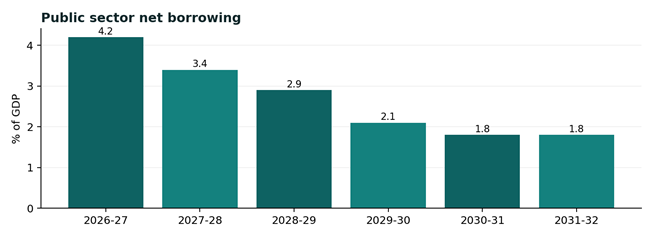
Figure 1. Annual GDP growth, per cent. Source: OBR October 2026, Treasury Budget Table 1.1.
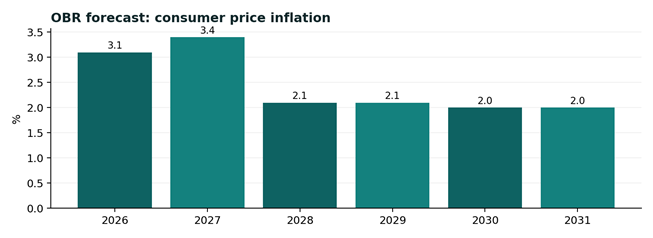
Figure 2. Annual CPI inflation, per cent. Source: OBR October 2026, Treasury Budget Table 1.1.
The Treasury reports that higher debt interest is around £14bn per year above the March forecast. Borrowing is forecast to decline from 4.2% of GDP in 2026-27 to 1.8% in 2031-32. These fiscal constraints limit the room for further departmental settlements and mean pressures may be shifted across years or budgets.
Figure 3. Public sector net borrowing, percentage of GDP. Source: OBR October 2026, Treasury Budget Table 1.2.
2. Council funding and local government finance
The major change is fiscal devolution
From April 2027, mayors are to receive a share of business rates income and a permanent 20% share of growth, alongside adjustments to specified central grants. Government intends local and regional government to retain 100% of business rates income before the end of the decade, with local authorities retaining at least 70%. These are policy intentions, not a uniform immediate uplift to district or unitary council spending power.
Nine proposed business rates retention zones could allow billing authorities to retain 100% of growth above agreed baselines for 25 years, subject to approval and legislation. Good Growth Funds receive £285m in 2027-28, and a £1.5bn mayoral borrowing facility is planned from April 2028. Strategic Authority capacity funding rises by £150m in 2027-28.
The PWLB statutory lending limit rises from £135bn to £155bn, with a possible later increase to £175bn. Separate debt relief of £500m for Woking and £200m for Thurrock is targeted at those councils and must not be treated as a general bailout mechanism.
Service consequence: Councils with strong commercial growth may benefit, but high-need areas with weak growth may become more dependent on redistribution and equalisation. Net benefit depends on baselines, grant substitution, tariffs, top-ups and risk-sharing still to be settled.
Demand-led spending remains the key challenge. Adult and children’s social care, special educational needs, temporary accommodation and homelessness can rise faster than the underlying tax base. Section 151 officers should model real-terms resource trends, sensitivity to commercial growth and the interaction with the 2027 Spending Review.
3. Council tax and Council Tax Reduction
The Budget introduces a £100 Household Energy Payment for households in council tax bands A to D in England, to be delivered through councils from January 2027, alongside £100m for local authorities to support households acutely affected by energy bills. The Treasury also describes a direct payment into bank accounts. Detailed delivery rules, data matching and treatment of non-standard cases need careful implementation.
This is household energy assistance, not a permanent £100 reduction in annual council tax liability. Councils should avoid describing it as a council tax discount and clarify eligibility, payment route and the treatment of empty homes, exemptions and households with no net council tax to pay.
The High Value Council Tax Surcharge is scheduled from April 2028 for homes worth over £2m in England. The Budget confirms plans for deferrals, discounts, exemptions and a 100% premium on properties left empty for at least 12 months. It is a central government charge collected through local administration, not automatically additional discretionary council revenue.
Collection and CTR implications: One-off cash support may improve immediate liquidity for eligible residents, but it does not resolve debt vulnerability. Councils should track payment plans, arrears, CTR eligibility and hardship referrals, rather than assuming increased collection simply because a rebate has been paid.
For Council Tax Reduction specifically, the Budget does not announce a universal national working-age CTR scheme. Locally designed schemes remain sensitive to changes in incomes, benefits, rents and inflation. Councils should run household scenarios, especially on thresholds and cliff edges, before setting their 2027-28 schemes.
4. Welfare and household taxation
The most visible near-term relief is removal of 5% VAT on domestic electricity until 1 July 2027, coupled with the 5p fuel duty cut until the same date. The Government estimates the electricity measure will take around £50 off the April 2027 annual Ofgem price cap. The £100 payment is restricted to qualifying council tax bands A to D in England; band is an imperfect proxy for household means.
The universal credit surplus earnings threshold remains £2,500 for a further year from April 2027. New fraud and verification activity includes 2,000 DWP specialists undertaking UC checks from April 2027; additional scrutiny of time abroad; and Pension Credit capital redeclarations from January 2028. Restricting repeated UC new-claim advances where previous advance debt remains is proposed from 2029, with exemptions.
A 100% taper of Carer’s Allowance earnings above the earnings limit is planned within 2030-31, replacing the current hard withdrawal above that point. A new parental allowance is planned from April 2029 for eligible fathers, partners and adopters. An adjusted State Pension triple lock is proposed from the next Parliament, so it should not be reported as an immediate change to current pension awards.
Headline rates of Income Tax, employee National Insurance and VAT are not increased by the Budget. However, tax on property and savings income rises by two percentage points from April 2027, the trading allowance rises from £1,000 to £3,000, and the cash ISA allowance remains £20,000. A temporary bank surcharge funds some household relief. For different residents, gains from energy support may coexist with other pressures on disposable income.
The Treasury distributional analysis finds that, on average, households in the lowest income deciles benefit most as a share of net income from the modelled Budget 2026 decisions. The benefit is small compared with the cumulative effects of policy since 2024, and the analysis excludes several indirect costs, business taxes and behaviour changes. Importantly, its income deciles are ranked before housing costs. For households facing expensive rents, after-housing-cost resilience may tell a very different story.
5. Business rates and the local economy
From April 2027, qualifying retail, hospitality and leisure premises in England receive 100% Small Business Rate Relief up to £18,000 rateable value, increased from £12,000. The tapered relief range extends to £21,000, from £15,000. Pubs, social clubs and qualifying live music venues receive 35% relief, increased from 15%. A two-year scheme limits certain RHL bill rises to CPI inflation, with extensions to small-business transitional support and a 1p transitional supplement.
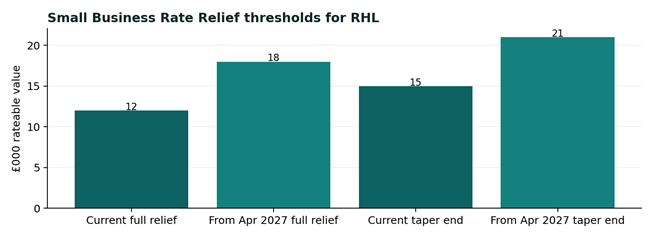
Figure 4. Small Business Rate Relief thresholds, £000 rateable value, for qualifying RHL properties. Source: HM Treasury Budget 2026 Policy Costings, pp. 20-22.
These measures should help some smaller businesses survive and invest, though rateable value, other eligibility rules and revaluation movements still matter. Billing services must identify qualifying properties correctly, amend software and notices, reconcile relief funding, and communicate transitional cases without implying all businesses receive a cash reduction.
A deeper strategic question is whether stronger rates retention will change council behaviour towards commercial land, planning decisions and economic development. Growth receipts should be assessed against displaced costs, service demands and the volatility of the local rating list.
6. Social housing, homelessness and supported accommodation
The Budget commits an additional £1.5bn to support around 10,000 social and affordable homes in England, prioritising Social Rent and council homes. This takes the ten-year Social and Affordable Homes Programme above £40bn, but it is a multi-year capital programme rather than an immediate increase to housing management revenue. Council housebuilding also benefits from a further year of PWLB preferential borrowing at 40 basis points below the standard rate.
From April 2027, the sale of land to eligible registered social housing providers will receive zero-rated VAT treatment in defined circumstances. Government estimates a relatively modest direct tax cost, so this should be seen as a targeted incentive rather than a complete solution to site viability.
Rough sleeping investment supports a route off the streets and longer-term accommodation. The policy costing estimates Exchequer costs of £175m in 2026-27, £515m in 2027-28 and £580m in 2028-29, including accommodation, support and benefit interactions. These are modelled public costs, not sums automatically allocated to local housing authorities. The Budget also announces a supported housing licensing regime in 2027-28 to enforce national standards in England.
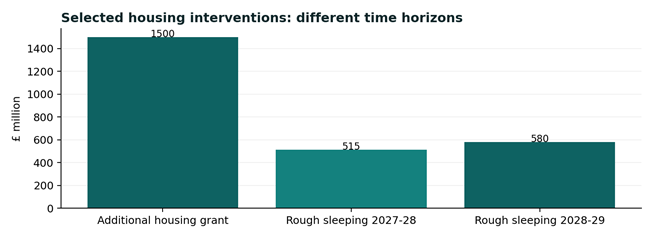
Figure 5. Selected housing measures in £m. The £1.5bn is multi-year programme funding; rough sleeping figures are annual Exchequer costings and are not directly additive. Sources: Budget 2026 and Policy Costings, pp. 36-37.
Service consequence: Councils should link capital programmes, temporary accommodation demand, supported housing regulation, homelessness prevention and Housing Revenue Account business plans. More homes will take time to deliver; prevention and move-on capacity must be strengthened now.
7. Artificial intelligence and the future of council services
Budget announcement: The government will make MHCLG’s PlanAssist frontier AI tool available to all councils in England by the end of 2027, subject to testing. It also intends to require key planning documents to be digitised and published as open data by that date. These are specific commitments relevant to local planning, not an announcement that every council service will receive a funded AI solution. Source: Budget 2026, paragraph 2.19.
The Budget allocates £35m to establish GovAI and £50m for a Civil Service AI transformation fund across 2027-28 and 2028-29. These are central Civil Service programmes. The separate £15m AI Challenge Prize will initially focus on NHS challenges. Councils should not count any of these sums as additional local government funding. Source: Budget 2026, paragraphs 2.15 and 2.18.
Where the operational opportunities lie
For revenues and benefits, there is potential to use carefully governed AI for correspondence triage, plain-English explanations, policy comparison, quality assurance of drafted letters, assisted staff knowledge searches, and modelling of aggregate collection and Council Tax Reduction outcomes. In housing, AI may help organise case information, identify missing documents, support homelessness prevention workflows and interpret stock or temporary accommodation trends. These are Visionary Network assessments of potential applications, not funded Budget programmes.
The strongest near-term opportunity is to take repetitive administration out of professional work while retaining accountable human decision-making. Automated recommendations must not become unreviewed benefit, recovery, safeguarding or homelessness decisions. Any implementation needs a lawful basis, a data protection impact assessment where required, procurement and security assurance, equality testing, demonstrable accuracy, an appeal or correction route and clear human oversight. Identifiable or pseudonymised household case data should not be entered into unapproved public AI systems.
Service impact: Councils should choose a small number of measurable use cases, establish the current cost and service standard, and test whether AI saves staff time without increasing error, complaints or exclusion. Reorganisation adds urgency: contracts, data access, records management and AI governance need to operate across successor councils rather than becoming another legacy-system problem.
8. Local government reorganisation and fiscal devolution
Budget announcement: The Fiscal Devolution Roadmap envisages income tax assignment for mayors from 2028 and a move towards 100% local and regional business rates retention by the end of the decade, with a minimum 70% local authority share. This is intended to replace elements of central grant. The detailed funding baselines will be set in the 2027 Spending Review, so retention percentages should not be interpreted as equivalent increases in council spending power. Source: Budget 2026, paragraphs 4.60 and 4.66.
The Budget identifies new strategic authority agreements, including Surrey, and says that the model for Kent and Medway depends on the compatibility of the Local Government Reorganisation outcome. This is evidence that devolution structures and reorganisation must be planned together, but the Budget does not set a comprehensive new timetable or general transition-funding settlement for all council reorganisations. Source: Budget 2026, paragraphs 4.67-4.68.
Has the Budget restarted or cancelled LGR?
No. The Budget of 28 October 2026 neither announces the acceleration or resumption of the paused Local Government Reorganisation (LGR) programme nor abandons it. Its commitments to fiscal devolution, strategic authorities and local leadership should not be read as a decision about the structural reorganisation timetable. The Budget leaves open whether paused proposals will resume unchanged, be amended, be further delayed or be discontinued in particular areas. Source: Budget 2026, chapter 4; MHCLG, LGR programme review letter, 7 September 2026.
The September 2026 position therefore remains the relevant programme baseline. Ministers withdrew decisions for Essex, Southend-on-Sea and Thurrock; Hampshire, Isle of Wight, Portsmouth and Southampton; Norfolk; and Suffolk. They paused implementation of 14 further decisions and included Cambridgeshire and Peterborough and West Sussex in the review. The government did not announce the end of LGR, but it had not confirmed a replacement national implementation timetable in the Budget. Source: MHCLG, 7 September 2026 programme review and decisions withdrawal letter.
Surrey is the important exception. The creation of East Surrey and West Surrey was already established in law and was expressly excluded from the September review. The new councils remain scheduled to assume their functions on 1 April 2027. The Budget’s reference to a potential Kent and Medway strategic authority model depending on LGR outcomes demonstrates that devolution plans may need to accommodate different reorganisation outcomes. Source: MHCLG programme review letter; Budget 2026, paragraphs 4.67-4.68.
Implications for councils while decisions are unresolved
The uncertainty is not cost-free. Councils may already have incurred expenditure on programme teams, consultancy, contract discovery, organisational design and ICT preparation. Some must now retain capacity without a confirmed timetable, while maintaining statutory services, retaining experienced staff and planning financial settlements. It would be unsafe to book unapproved reorganisation savings or assume reimbursement of sunk transition costs. In a 15 September parliamentary answer, ministers acknowledged costs already committed and said they would consider the matter during the review, not that reimbursement had been agreed.
A proportionate response is to maintain three distinct planning scenarios: (1) existing structures continuing for longer; (2) a revised or delayed implementation programme; and (3) a decision not to proceed in the affected area. For each, quantify sunk and avoidable transition expenditure, workforce and contract exposure, recurring service costs and the point at which any claimed savings could realistically accrue. Preserve existing evidence and data mapping work, but do not incur irreversible costs without an approved delivery mandate.
For revenues and benefits, this means keeping Council Tax Reduction harmonisation and common collection-policy work in a state that can be restarted if required, while ensuring that current councils still make timely, lawful decisions on their own schemes. Similarly, business rates forecasts must distinguish the fiscal devolution roadmap from the unconfirmed future boundaries and structures of the billing authorities.
Visionary Network assessment: The Budget signals continued support for devolution, not a green light for the previously paused LGR timetable. Pending the government’s review, councils should retain flexibility, protect service continuity and make the costs of uncertainty visible in their medium-term financial planning.
The government also confirms £285m for Good Growth Funds in 2027-28, including £120m of incubator capital for places moving towards a devolution deal or strategic authority status, alongside £150m in strategic authority capacity and capability funding and a proposed £1.5bn borrowing facility for mayoral strategic authorities from April 2028. These have defined purposes and eligibility and are not unrestricted funding for the creation of new unitary councils. Source: Budget 2026, paragraphs 4.64-4.66.
What this means for successor councils
The key financial risk is treating reorganisation as a savings exercise before understanding the cost of harmonisation. Successor authorities may inherit different Council Tax Reduction schemes, recovery policies, discount and exemption practices, council tax bases, collection performance, IT contracts, benefit caseload characteristics and accounting arrangements. Equalising them creates winners and losers, transition costs and significant equality and consultation considerations.
In revenues and benefits the practical priorities are a common data dictionary, a reconciled baseline across legacy councils, a defensible CTR options model, agreed billing and collection policies, systems integration, and worked examples showing the effect on residents. The modelling should also consider the implications of business rates retention, resets, pooling and grant substitution where applicable. These are professional planning implications, not separate promises in the Budget.
Service impact: Councils entering reorganisation should maintain separate financial scenarios for business as usual, one-off transition expenditure and recurring harmonised service costs. Decisions on CTR and collections should be tested for equality, affordability and collectability. New councils will need credible governance for shared data and AI, with a clear point at which the risks and costs of legacy arrangements transfer to the successor authority.
9. Household and service impact assessment
| Household or service | Potential benefit | Risk or unresolved issue |
| Low-income family in band B | £100 energy payment; lower electricity VAT | Rent, food and council tax debts may still exceed relief |
| Pensioner with modest State Pension | Pension tax allowance safeguard | Eligibility, benefit take-up and housing costs still matter |
| Working carer | Future Carer’s Allowance taper | Not immediate; interacts with UC earnings and deductions |
| Small hospitality business | Higher relief and bill protections | Revaluation, cash-flow, other employment and energy costs |
| Council tax and benefits team | Chance to identify households needing help | New data, payments, contact demand and fraud controls |
| Housing authority | New capital and rough sleeping programmes | Delivery delays, TA costs, supported housing licensing capacity |
10. What councils should do now
Finance and strategy: Prepare a 2027-28 to 2031-32 scenario with inflation, service demand, business rates retention, grant offset, borrowing and collection assumptions.
Revenue and benefits: Develop a delivery plan for the £100 payment, including eligibility, exceptions, communications, complaints, data assurance and interaction with CTR and local welfare assistance.
Household resilience: Identify households near CTR thresholds, in arrears or facing multiple debts. Test the net effect of national changes using worked examples and after-housing-cost measures.
Business rates: Segment the rating list to estimate new relief eligibility, changing business bills and operational implications. Explain changes early to qualifying businesses.
Housing and homelessness: Update the HRA plan and social housing pipeline, assess PWLB financing, and build a joint homelessness, supported housing and TA prevention plan.
Governance: Undertake equality and distributional impact assessments, scrutinise data sharing and protect residents from confusion between grants, tax credits and bill reductions.
AI and transformation: Audit existing uses, prioritise well-governed, measurable use cases and ensure training, procurement, privacy controls and human review are in place before deployment.
Reorganisation: Prepare a legacy-to-successor finance and policy map, including CTR harmonisation, council tax collection, business rates, IT integration, workforce and one-off transition costs.
11. Questions for elected members and senior officers
• How much genuinely additional, spendable resource reaches this council after grant substitution and inflation?
• Are we using council tax collection and CTR policy to support sustainable payments or simply shifting vulnerable households into enforcement?
• Which businesses benefit from the new reliefs and what happens to those outside the qualifying sectors?
• Can the housing programme be delivered at pace while maintaining existing stock and managing HRA pressure?
• Are local interventions reducing the total cost of household financial crisis across council budgets?
• What demonstrable service benefit will AI deliver, and who will be accountable for errors and data protection?
• How will reorganisation and fiscal devolution change the council’s true net spending power, and who bears the cost of harmonisation?
Evidence, qualification and sources
This is an initial Budget-day assessment. Announced policies, OBR forecasts and local professional judgements are separated in the narrative. Some fiscal devolution, surcharge, housing and operational provisions remain subject to legislation, detailed guidance, funding allocation or the 2027 Spending Review. No authority-specific settlement, CTR caseload projection or after-housing-cost distributional model has been assumed.