
By Malcolm Gardner, Visionary Network
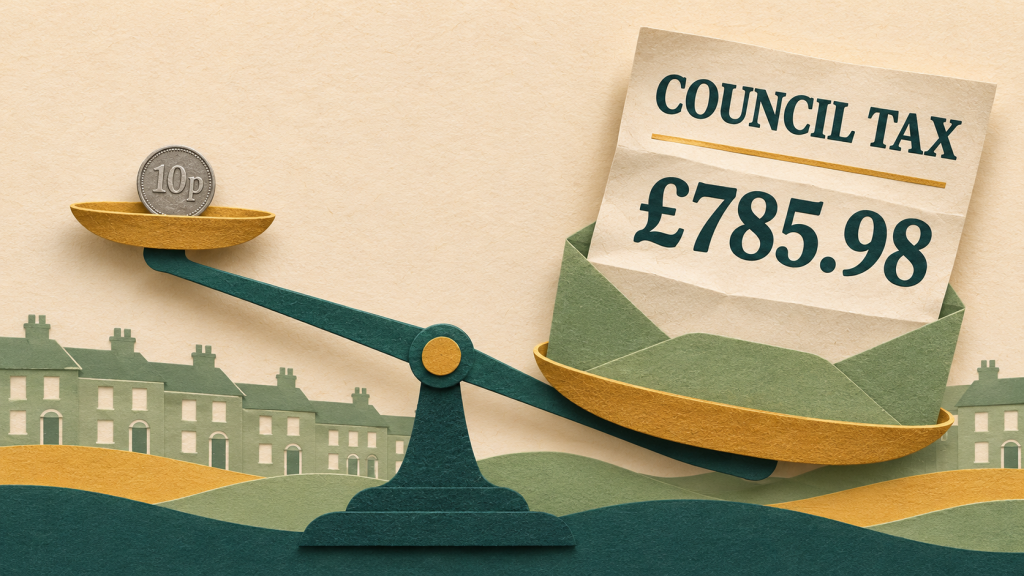
Andy Mitchell’s weekly income changed by ten pence when he moved from income-related Employment and Support Allowance to Universal Credit. His Council Tax Reduction fell from 100% to 10%. Somerset Council sent him a bill for £785.98 for the remainder of the financial year. The move was part of the government’s managed migration programme, and he had no choice about it. The National Archives
I keep coming back to those ten pence. If I were putting a Council Tax Reduction scheme in front of elected members, I would want them to see Mr Mitchell’s old and new bills side by side. Then I would ask them what had changed in his ability to pay that justified the difference. That is the question a good scheme design process should answer before a resident ever sees a bill.
What happened in Somerset
Under Somerset’s 2025/26 scheme, someone receiving income-related ESA qualified for a full reduction. For someone on Universal Credit, the council counted the award as income apart from the housing costs element. That meant it counted the additional amount Mr Mitchell received because his disability limited his ability to work. The change in benefit triggered a sharp change in Council Tax Reduction even though his income had barely moved. The National Archives
On 12 November 2026, the High Court found that applying the rules to Mr Mitchell amounted to unlawful discrimination. It quashed the decision on his individual liability and required Somerset to determine it afresh. The court also found that the council had failed to comply with the public sector equality duty when it adopted the 2025/26 scheme. The quashing order applied to Mr Mitchell’s decision. The judgment’s reasoning gives other councils a clear basis for reviewing their own rules. The National Archives
Start with the household and follow the bill
At Visionary Network, we start with what a scheme does to people’s bills. The total cost matters, but a borough-wide figure can look reassuring while a relatively small group of households takes a substantial hit. Members need to know who gains, who loses, how much they lose and what causes that loss. A small saving on the scheme budget can mean a very large bill for the people affected. Visionary Network
That means modelling the same household before and after a change. Take a disabled resident on legacy benefits and follow them through to Universal Credit. For an income-banded scheme, see whether counting a disability-related element moves them into a lower award band and what that does to their annual bill. Test households either side of the band threshold. Then look at how many residents would face similar increases and what that might mean for collection, arrears and the work of the revenues and benefits team.
Councils going through local government reorganisation should ask the same questions when they harmonise their schemes. A single set of rules can have quite different effects on households coming from different legacy schemes. Show members those differences, alongside the cost and practical implications of any protection they could put in place. Visionary Network
Review the rules you intend to keep
One of the most important findings in Mitchell concerns a rule that Somerset carried forward. The council’s equality assessment focused on proposed changes, even though members were adopting the whole scheme. A consultation response had already drawn attention to the effect of moving to Universal Credit. The court found that the council had failed to give due regard to that effect on disabled residents. The National Archives
An annual review can be light on amendments and still need serious analysis. A rule can stay exactly as drafted while the benefits system around it changes, putting a different group of people at a disadvantage or increasing the number affected. When a consultation response identifies a credible problem, test it and put the result in front of members while they can still act on it.
Build foreseeable protections into the scheme
A hardship scheme has an important place. It gives councils room to help when a household faces circumstances the main scheme could not reasonably anticipate. In Somerset, however, the court found that discretionary support did not adequately address a foreseeable disadvantage affecting an identifiable group. Requiring someone to make a further application for discretionary help is itself a different experience from having the protection built into their entitlement. The National Archives
If the modelling shows that the same rule repeatedly produces a sharp loss for disabled residents, look at the rule first. A targeted income disregard, a different band threshold or transitional protection may each be worth testing. The right choice depends on who is affected, how long the protection is needed, what it costs and whether the council can administer it reliably. It also needs to be written clearly enough that the resident, the assessment officer and the software supplier all understand how it works. Visionary Network
Before members vote, put a handful of anonymised household examples alongside the financial and equality analysis. Show the old bill, the new bill and the rule that makes the difference. Give members enough information to explain that difference to the person who will have to pay it. In Mr Mitchell’s case, that conversation would have started with ten pence.
Read the High Court judgment · Visionary Network’s Council Tax Reduction design and rewriting service