

The Conservatives want to cut Universal Credit for some long-term unemployed people and control what they can spend it on. Britain has been here before. So has Australia. The evidence is rather less straightforward than the headlines.
There is something instantly attractive about a simple proposition.
If taxpayers provide somebody with money because they cannot support themselves, is it unreasonable to say that public money should pay for food, heating and other essentials rather than alcohol, cigarettes or gambling?
On Wednesday 23 September, the Conservatives turned that proposition into a significant new welfare policy.
Under the plan, people judged capable of work would initially receive their full Universal Credit entitlement for six months. Beyond that, entitlement to the full standard allowance would increasingly depend upon their employment and National Insurance contribution history. Broadly, every two years previously worked would secure a further year at the full rate. Someone without sufficient contribution history would instead receive a new “Subsistence Allowance” worth 70% of the standard allowance.[1]
That reduced allowance would not simply arrive in the claimant’s bank account. It would be loaded onto a “Back to Work” card, preventing cash withdrawals and blocking expenditure on alcohol, tobacco and gambling. Housing and child-related elements would be unaffected, while people already working and those assessed as having limited capability for work and work-related activity would be excluded.
The Conservatives estimate that around 350,000 people would move onto the lower rate, producing savings of about £538 million a year.[1]
Kemi Badenoch’s political argument is equally straightforward: welfare should be a safety net rather than, in her words, a “lifestyle choice for those who can’t be bothered”.[1] That is a powerful political line. But is it an accurate description of the welfare system?
And even if we accept that some people could work but do not, is reducing their income by 30% and then restricting how the remaining money can be spent an effective way of changing their behaviour? Those are two different questions.
First, we need to stop treating everyone on Universal Credit as unemployed
In May 2026 there were about 8.4 million people on Universal Credit. But 4.3 million — 51% — were in the “no work requirements” conditionality group. A significant part of the increase in that group has resulted from the migration onto UC of people previously receiving health-related legacy benefits such as Employment and Support Allowance.[2]
There were also 3.1 million UC recipients recorded as being in employment in April, equivalent to 37.7% of the caseload.
The group formally classified as “searching for work” numbered about 1.6 million in May.[2]
So there plainly is an unemployment and economic inactivity problem. But “8.4 million people on Universal Credit” cannot legitimately be translated into “8.4 million people choosing benefits instead of work”.
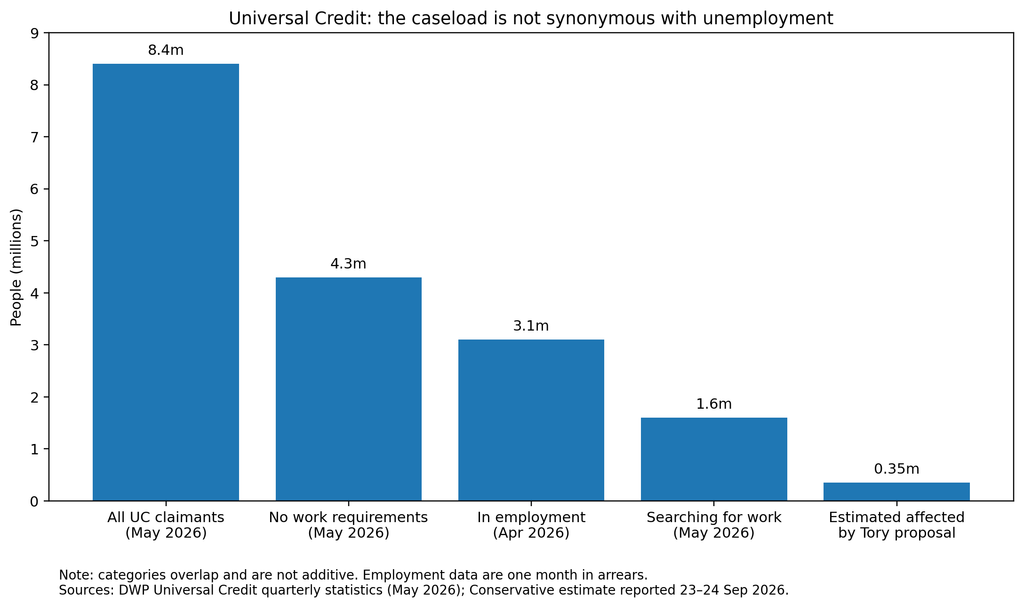
The Conservatives themselves estimate that their new policy would affect about 350,000 people. That is a significant number of individuals. But it represents only around 4% of the total Universal Credit caseload. It matters because language shapes the policy problem we think we are solving.
Is there evidence for a “life on benefits”?
There is evidence which should concern anybody interested in a sustainable welfare system.
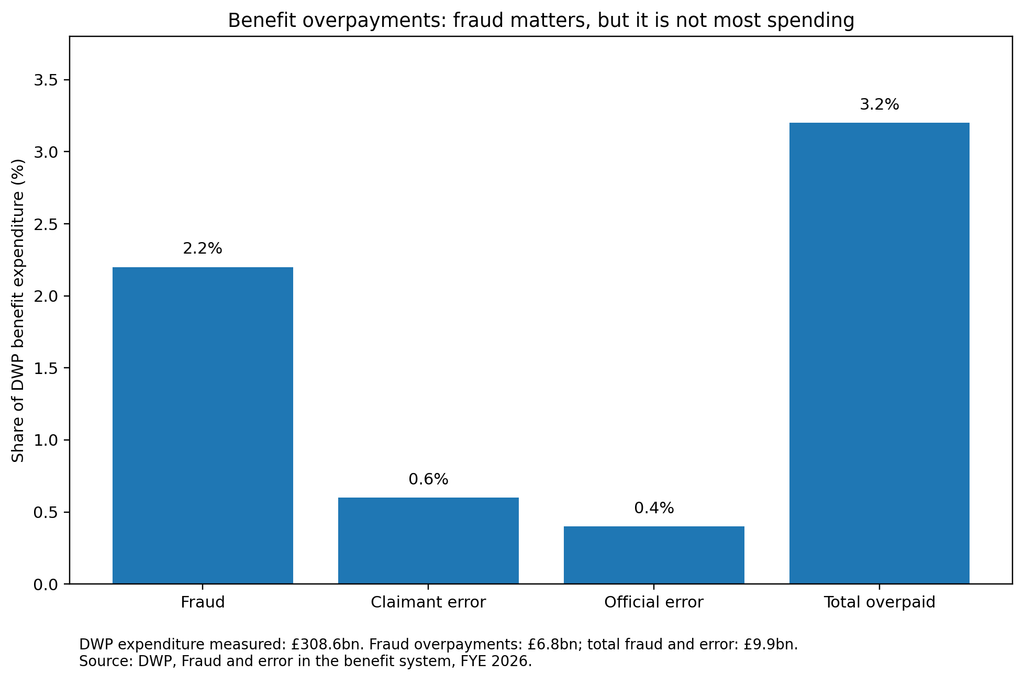
Fraud is not imaginary. DWP estimates that in 2025/26, 2.2% of benefit expenditure — £6.8 billion — was overpaid because of fraud. Total overpayments resulting from fraud and error were estimated at £9.9 billion, or 3.2% of expenditure.[3] Those are substantial sums of money and there is no reason to minimise them. Equally, they need to be presented in proportion. Fraud accounts for an estimated 2.2% of DWP benefit expenditure, not most of it.
Nor is the wider pressure from welfare expenditure invented.
UK social-security expenditure was forecast at £333.7 billion in 2025/26. But around 55% of Great Britain social-security expenditure goes to pensioners. Working age and children’s welfare accounted for about £145 billion.[4]
This is important because discussions about the “welfare bill” often move almost imperceptibly from total social-security spending to a discussion about unemployed working-age people, as though they were the same thing. They are not.
The Centre for Social Justice makes a more challenging argument. Its Welfare 2030 work calculates that an economically inactive person qualifying for Universal Credit because of ill health, receiving an average housing element and Personal Independence Payment, could receive around £25,200 a year. It estimates that 6.2 million full-time employees have post-tax earnings below that figure.[5]
That deserves serious consideration. It raises legitimate questions about replacement rates, low wages and whether the relationship between employment and benefit entitlement always provides the incentives policymakers intend.
But it does not mean that 6.2 million working people could resign tomorrow and automatically receive £25,200 in benefits. The calculation depends upon entitlement to a particular combination of Universal Credit health support, housing support and PIP. PIP is also not an unemployment benefit and may be received by people who work.
So the CSJ analysis tells us something useful about incentives in certain circumstances. It does not establish that millions of people have a freely available choice between employment and an equivalent benefit income.
There is another important complication. Much of the health-related population behind that comparison appears to fall outside the principal group the Conservatives say their Back to Work card would target.
Some of the strongest evidence used in the general argument about welfare incentives is therefore not necessarily evidence about the people covered by this particular proposal.
What does the evidence say on the other side?
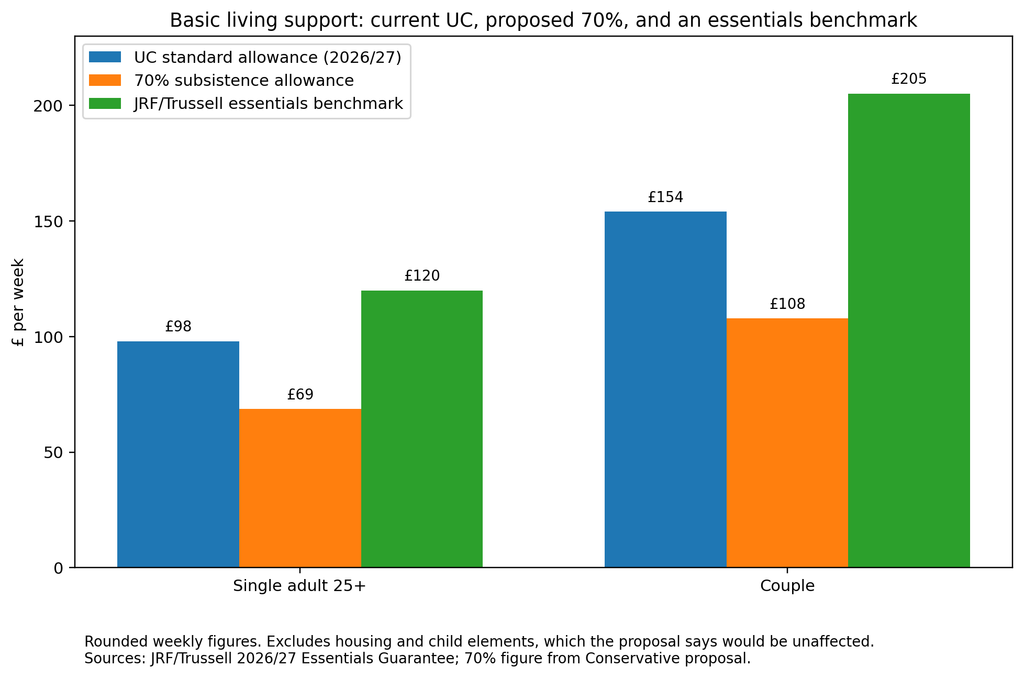
It is difficult to reconcile the idea of generally comfortable benefit dependency with the financial position of many households actually receiving Universal Credit. Joseph Rowntree Foundation and Trussell estimate that a single adult requires at least £120 a week for basic essentials excluding rent and Council Tax, and a couple around £205.[6] Their 2026 work also reports that around five in six low-income households receiving Universal Credit are going without at least one essential.[6]
These are not official government measures of subsistence and should not be presented as such. They are independently developed adequacy benchmarks. But they provide an important counterweight to the image of benefit claimants generally enjoying a comfortable alternative to employment. Reduce the present standard allowance to 70%, and the gap between benefit income and that independently estimated cost of essentials becomes larger.
The Resolution Foundation adds another part of the picture. Its recent work on housing suggests that more than 1.1 million low-income renting families face growing affordability pressures because Local Housing Allowance has failed to keep pace with rents, with substantial weekly shortfalls between housing support and actual rents.[7]
Again, that does not settle the argument about whether some benefit recipients could work. But it matters when considering a proposal to reduce the disposable income of people already facing gaps between benefit provision and essential household costs.
Surely restricting benefits to essentials is fair?
This is where the debate becomes more interesting, because there are actually three different policies contained within the Conservative proposal.
The first is contributory welfare: somebody who has spent many years paying into the system should arguably receive greater protection when they lose their job than somebody with little or no contribution record.
The second is financial conditionality: after a period without employment, the amount of benefit falls.
The third is expenditure control: the state determines some of the things on which the remaining benefit can be spent.
These propositions do not necessarily stand or fall together.
There is a coherent insurance argument for the first.
Indeed, Germany and the Netherlands already make greater use of contributory unemployment insurance, with initial payments linked to previous earnings and duration linked to contribution history.[1] That is quite different from saying that once somebody has exhausted their contribution entitlement, their means-tested subsistence benefit should both fall substantially and become subject to restrictions on how it is spent. Britain could design a more contributory unemployment insurance system without introducing a welfare card at all.
Does making benefits tougher get people into work?
Here I think opponents of the proposal need to be careful. It would be too strong to say that there is no evidence that conditionality works.
The Institute for Fiscal Studies examined a DWP study of Universal Credit sanctions in 2023 and concluded that the methodology of that particular study meant relatively little weight should be placed on its causal findings. But the IFS also pointed to international evidence from Denmark, the Netherlands, Germany and Switzerland which generally finds that sanctions increase employment, sometimes by significant amounts.[8]
There are substantial qualifications.
Sanctions remove income from households which already have low incomes. They can cause hardship. Moving somebody off benefits is not necessarily the same thing as moving them into sustainable employment, and the quality and duration of the employment matters. Nevertheless, if the proposition is simply that financial incentives, work-search requirements and conditionality can affect behaviour, there is evidence supporting it.
That modifies my own starting position.
The evidential weakness is much more specific.Where is the evidence that controlling what somebody can buy with their remaining benefit payment produces better labour-market outcomes? A sanction and a spending card are not the same intervention. Britain has been here before.
The welfare card sounds new. It isn’t.
On 18 December 2012, Conservative MP Alec Shelbrooke introduced a Ten-Minute Rule Welfare Cash Card Bill. His proposal was explicitly designed to encourage what he described as responsible spending of welfare payments. Interestingly, Shelbrooke also cautioned against portraying all benefit recipients as idle, saying that the policy was aimed at changing the behaviour of a minority rather than condemning everybody receiving benefits.[9] The proposal received its first reading but did not become government legislation.
Then came a second attempt. Under Iain Duncan Smith, DWP explored prepaid benefit cards and subsequently carried out a small-scale live test in Kent in 2015. The resulting evaluation was published in July 2016.[10]
What the DWP trial actually found: The Kent experiment is particularly relevant because it allows us to distinguish between the rhetoric surrounding welfare cards and what Britain has actually tested. The trial was voluntary. It did not impose compulsory restrictions on what claimants could buy. Its principal purpose was to see whether prepaid cards could be used successfully to pay benefits, particularly to vulnerable claimants and people who needed assistance with budgeting.[10]
The scheme had capacity for up to 150 people. Seventy-two volunteered, 55 activated their cards and five subsequently dropped out.[10]
The evaluation found genuine advantages. Some people without conventional bank accounts found the cards useful. Users could pay bills, establish Direct Debits and make purchases without risking an overdraft. The researchers concluded that prepaid-card technology was feasible and had the potential to support financial inclusion and budgeting.[10] That is evidence in favour of prepaid-card technology. But it is not evidence that compulsory expenditure control changes behaviour.
Participants were given the opportunity voluntarily to block certain merchant categories. None chose to do so. The researchers therefore explicitly said they could not evaluate the effectiveness of merchant blocking.[10] And the evaluation identified a problem which goes directly to the heart of today’s proposal. Payment cards traditionally identify the type of merchant rather than every individual product being purchased. Blocking a betting shop may be relatively straightforward. Stopping somebody buying wine at a supermarket without simultaneously preventing them from buying bread, nappies or washing powder is rather more complicated.
The DWP evaluation specifically noted that individual merchant categories could be blocked, but individual products could not. Local-authority participants also told researchers that restricting items such as alcohol and tobacco was difficult because those products were sold by supermarkets and convenience stores that could not realistically be blocked altogether.[10]
Technology has advanced since 2015, and Australia subsequently developed product-level restrictions with participating retailers.
So it would be wrong to argue that an item-level system is technologically impossible. But it requires something significantly more sophisticated than simply issuing a debit card. It also raises questions about retailers, transaction data, exemptions, system failures, administration and what happens when somebody genuinely needs cash.
Why didn’t the Conservatives introduce it last time?
There is no single document which says: “The Government rejected welfare cards for these reasons.” We should therefore resist constructing a convenient explanation after the event. The historical record tells us something narrower. Shelbrooke’s proposal was a backbench Bill rather than government legislation. DWP subsequently investigated prepaid cards and conducted the Kent experiment. That experiment showed that prepaid cards could work technically, but it did not demonstrate the effectiveness of compulsory spending restrictions. And despite having a Conservative majority government after 2015, a nationwide compulsory welfare-card system was not introduced.
We cannot say from the evidence that the 2016 evaluation killed the policy. What we can say is that Britain’s previous experiment did not provide the evidence that would now be needed to claim that compulsory restrictions improve employment outcomes.
Australia: the obvious test case
Australia went much further. Its Cashless Debit Card allocated a portion of specified welfare payments to a restricted account. Cash withdrawals were limited and expenditure on alcohol, gambling and certain cash-like products was prevented.
This was not a small proof-of-concept exercise. By February 2022 there were around 16,685 active participants and the programme cost A$36.5 million in 2020/21 alone.[11] The Australian National Audit Office’s assessment is therefore particularly important. In its 2022 follow-up audit, the ANAO concluded that although administrative oversight was largely effective, the Department of Social Services had “not demonstrated that the CDC program is meeting its intended objectives”. It also found weaknesses in performance measurement, cost-benefit analysis and evaluation.[11]
That is not the same as proving that the card had no positive effects. It means the Australian government had not demonstrated through adequate evaluation that the scheme was achieving the outcomes claimed for it. Australia subsequently legislated to abolish the Cashless Debit Card. All participants had moved off it by March 2023.[12]
But there is an important correction to the simpler version of that story. Australia did not abandon income management entirely. An Enhanced Income Management programme continues, including compulsory categories in some areas and a SmartCard system.[12] So “Australia tried it and scrapped it” is too simplistic.
A more accurate conclusion is that Australia operated one of the world’s largest experiments in cashless welfare, abolished the Cashless Debit Card itself, retained a modified form of income management, and was unable, according to its national auditor, adequately to demonstrate that the original programme was achieving its stated objectives. That is a much more useful lesson for Britain.
What about northern Europe?
Northern European welfare states are interesting because many are perfectly willing to impose obligations on people receiving benefits. But conditionality does not automatically imply restricting consumer expenditure.
Finland’s basic social assistance is generally paid into the recipient’s bank account. Kela can pay particular bills directly and can provide vouchers for specified expenses such as prescription medicines or glasses, but ordinary social assistance is not generally delivered through a card controlling day-to-day purchases.[13]
Norway operates individually assessed financial social assistance intended to cover things such as food, housing, electricity, clothing, communications and transport. Recipients can be required to participate in employment-related activities, and failure to meet conditions can affect entitlement.[14]
Sweden similarly defines categories of reasonable living expenditure and now has activity requirements for recipients of financial assistance, while the support itself remains financial assistance rather than a general restricted-purchase card.[15]
The international picture is therefore more nuanced than either side might suggest. There is extensive precedent for contribution requirements. There is extensive precedent for conditionality.
There is extensive precedent for requiring job search, training or other employment activity. There is far less evidence that restricting what ordinary unemployed households may purchase is the intervention responsible for improving employment outcomes.
What does the public think?
This may be where the politics and the policy begin to diverge. As at the morning of 24 September, I can find no published opinion poll asking voters specifically about this new Conservative Back to Work card proposal. So it would be wrong to say that the public either supports or rejects it. There is, however, recent evidence about wider public attitudes.
Ipsos polling conducted on 23–24 July 2026 found that 35% of British adults regarded helping people back into work as a top priority for the benefits system. There is also significant public scepticism towards aspects of the system. Forty-six per cent thought more people were attempting to obtain health benefits by falsely claiming conditions and 43% believed health benefits were awarded too easily.[16]
But when Ipsos asked what should be done about working-age economic inactivity, the public response was more mixed than a simple “cut benefits” narrative suggests. Retraining and skills support were among the most popular approaches. So was working with employers to create more flexible jobs. Tailored support for people with health conditions and incentives for employers also attracted significant support. Reducing benefits for people who were not looking for work was selected by 31%.[16]
Chart: What the public prioritises to tackle working-age worklessness
The polling therefore points in two directions simultaneously. There is meaningful public concern about welfare dependency, fraud and whether benefits provide sufficient incentives to work. But that does not mean the public’s preferred solution is simply to make benefits less generous. That distinction will be worth watching as polling specifically on the Conservative proposal begins to appear.
What about the right-wing press?
The early newspaper reaction demonstrates why the proposal may have considerable political appeal. The Daily Mail led its 24 September front page with “Kemi’s ruthless crackdown on Benefits Street”. The Daily Telegraph led with “Tories to ban spending benefits on alcohol”, while The Times prominently reported the plan to reduce support for the long-term unemployed.[17] That is substantial and generally favourable prominence from newspapers on the political right.
The Mail’s framing is particularly revealing. “Benefits Street” is not simply a description of a policy. It invokes a much wider cultural argument about welfare dependency, responsibility and deservingness. The Telegraph presentation focused strongly on preventing expenditure on alcohol, while The Times headline concentrated on the proposed reduction in benefits.[17]
I would nevertheless be cautious about saying simply that “the right-wing media supports the plan”. Prominent coverage is not the same as editorial endorsement, and the tone differs between publications.
What can reasonably be said at this stage is that the proposal has received highly prominent coverage across several right-of-centre newspapers, and that some of that coverage, particularly the Mail’s presentation, adopts language broadly sympathetic to the underlying argument that tougher welfare rules are required.
Perhaps the most difficult question is: what is an essential?
This is where the superficially simple welfare card becomes complicated. Food is obviously essential. So is electricity. But what about a bus fare to a job interview? Mobile data to search for work? A second-hand bicycle which makes employment accessible? A haircut before an interview? Replacing a broken kettle? Buying children’s clothes from a charity shop? Giving a child £5 for a school activity? Paying somebody for a lift? Buying something cheaply at a market where cards are not accepted?
A cash benefit allows a household with very little money to make trade-offs between competing needs. A restricted card transfers at least some of those decisions from the household to government, the card provider and the rules embedded within the payment system. That does not automatically make it wrong. But it does mean that “benefits should only be spent on essentials” is considerably easier to say than to administer.
The previous DWP experiment contained a small but important warning. Researchers found that apparently minor technical problems, such as a payment arriving a day late or a claimant being unable to pay a particular bill, could produce significant practical difficulties for people living on very limited incomes.[10]
Where does the evidence leave the argument?
My starting concern was that this type of policy risks dividing people into the deserving and undeserving poor without strong evidence that the mechanism itself works. Having looked at the evidence, I would refine that argument rather than abandon it. There is evidence that benefit design affects behaviour. There is evidence that conditionality and sanctions can increase movement into employment. There is a coherent case for examining whether someone with a long contribution record should receive greater unemployment protection. There is a genuine welfare-fraud problem. And it would be unreasonable simply to dismiss public concern about whether the welfare system creates the right balance between security and responsibility.
Those arguments need to be acknowledged. But they do not establish the case for a compulsory Back to Work spending card. Britain’s own experiment demonstrated that prepaid cards can function and may help particular people to budget. It did not demonstrate that compulsory restrictions on spending improve employment outcomes.
Australia provides much more substantial experience, but its national auditor concluded that the government had not demonstrated that the Cashless Debit Card was meeting its objectives.
The northern European systems examined here readily use contribution rules and employment conditionality without generally turning ordinary subsistence payments into restricted consumer spending cards.
And perhaps most importantly, there is a contradiction that needs addressing. If the purpose of the card is to ensure that public money is spent on essentials, it matters that independent research already suggests that the existing standard allowance leaves many households unable to afford all of those essentials. Reducing the allowance by another 30% does not resolve that arithmetic. It increases the gap.
That does not prove that the Conservative policy cannot work. The party may produce further evidence. A detailed scheme might contain safeguards, exemptions and technological solutions which are not apparent from the initial announcement. There may also be future evidence that the threat of the lower allowance itself changes behaviour before anybody reaches the card.
Those questions should be tested rather than prejudged. But based on the evidence available on the morning of 24 September 2026, the strongest conclusion I think we can reasonably reach is a narrower one.
- There is evidence that financial incentives matter.
- There is evidence that contribution-based unemployment insurance can work.
- There is evidence that welfare conditionality can affect employment.
- There is evidence that prepaid cards can technically administer benefit payments.
What there is not yet convincing evidence for is the additional proposition at the centre of this policy: that controlling how long-term unemployed people spend an already reduced subsistence benefit will itself move significant numbers of them into sustainable employment.
That distinction matters. The test should not be whether stopping someone buying a bottle of wine with benefit money sounds fair. The test should be whether the intervention actually changes the outcome we are trying to change. If it does, its supporters should be able to demonstrate it.
If it does not, then we risk creating a costly system which divides people, restricts individual choices and administers poverty differently without actually reducing it. That is the evidence the debate now needs.
Endnotes
This article is based on the policy details, official statistics, research and media coverage available on the morning of 24 September 2026. The Conservative proposals have only just been announced and further detail, including a fuller policy or costing document, may change some of the analysis.
- Initial details of the Conservative proposal, including the six-month period, contribution test, 70% Subsistence Allowance, Back to Work card, exclusions, estimated 350,000 people affected and £538 million saving: The Guardian, “Tories target universal credit claimants in plan condemned as ‘fast track to poverty’”, 23 September 2026; The Times, “Conservatives pledge to cut benefits for the long-term unemployed”, 24 September 2026; City AM, “Tory welfare crackdown would ban benefit spending on alcohol and cigarettes”, 23 September 2026. The Guardian
- Department for Work and Pensions, Universal Credit quarterly statistics to 14 May 2026. The statistics record 8.4 million people on UC in May 2026, 4.3 million in the no-work-requirements group, 1.6 million in the searching-for-work group, and 3.1 million in employment in April 2026. GOV.UK
- Department for Work and Pensions, Fraud and error in the benefit system, financial year ending 2026. Total overpayments were estimated at £9.9 billion, including £6.8 billion attributed to fraud. GOV.UK
- Department for Work and Pensions, Benefit expenditure and caseload tables: guidance and methodology. Forecast UK social-security expenditure for 2025/26 was £333.7 billion; in Great Britain around 55% was forecast to go to pensioners, with £145 billion spent on working-age and children’s welfare. GOV.UK
- Centre for Social Justice, “Welfare 2030 enquiry launched to produce detailed blueprint for reform”, January 2026. Its analysis estimates a combined health-related UC, housing and PIP package of around £25,200 and compares this with the earnings of 6.2 million full-time employees. The Centre for Social Justice
- Joseph Rowntree Foundation and Trussell, “Guarantee our Essentials”, January 2026. Their benchmark estimates minimum essential expenditure of £120 per week for a single adult and £205 for a couple and reports that around five in six low-income households receiving UC are going without essentials. Joseph Rowntree Foundation
- Resolution Foundation research reported in September 2026 on the growing gap between Local Housing Allowance and private rents, estimating that more than 1.1 million low-income renting families are exposed to the affordability squeeze. The Guardian
- Institute for Fiscal Studies, Tom Waters, “New DWP study on sanctions may not be all it seems”, 6 April 2023. The IFS questioned the methodology of the DWP study but noted that wider European research generally finds sanctions increase employment, while also identifying hardship and other potential consequences. Institute for Fiscal Studies
- House of Commons Hansard, Welfare Cash Card, Alec Shelbrooke MP, 18 December 2012. Shelbrooke proposed a welfare cash card while explicitly distinguishing the minority he wished to target from the wider benefit-recipient population. UK Parliament
- Department for Work and Pensions, Evaluation of the prepaid card live test, Research Report 926, July 2016. The Kent proof-of-concept was voluntary, had capacity for 150 participants, recruited 72 volunteers, saw 55 activate cards and five leave the scheme. No participant chose voluntary merchant blocking, so its effectiveness could not be evaluated. The study also identified the difficulty of preventing purchases of individual products such as alcohol and tobacco at supermarkets and convenience stores. GOV.UK
- Australian National Audit Office, Implementation and Performance of the Cashless Debit Card Trial — Follow-on, June 2022. The ANAO reported 16,685 active participants in February 2022 and programme costs of A$36.5 million in 2020/21, and concluded that the Department of Social Services had not demonstrated that the programme was meeting its intended objectives. Australian National Audit Office
- Australian Department of Social Services, “Changes to income management legislation”. Legislation abolished the Cashless Debit Card in September 2022 and all participants had moved off it by March 2023, but Enhanced Income Management subsequently continued in specified circumstances, including compulsory and voluntary categories. Department of Social Services
- Finland, Kela, guidance on social assistance. Basic assistance is generally paid into a bank account, although Kela can make direct payments and issue vouchers for specified needs such as prescription medicines and glasses. Kela
- Norway, NAV, guidance on financial social assistance. Assistance is individually assessed against essential living needs and recipients can be required to participate in employment or training activity. nav.no
- Sweden, Socialstyrelsen, guidance on financial assistance and 2026 activity requirements. Swedish assistance covers a defined range of reasonable living costs, while new rules require relevant recipients to participate in activities intended to improve employment prospects. Socialstyrelsen
- Ipsos, “Over a third of Britons back getting people into work as top welfare priority”, polling conducted 23–24 July 2026 among a representative online sample of 998 British adults aged 18–75. Thirty-five per cent identified getting people into work as a top welfare priority; 46% believed more people were attempting to cheat the health-benefit system and 31% prioritised reducing benefits for people not seeking work. Ipsos
- Newspaper front-page coverage, 24 September 2026. Sky News’ review records the Daily Mail’s “Kemi’s ruthless crackdown on Benefits Street” lead and The Times’ prominent coverage; contemporaneous coverage also records the Daily Telegraph’s “Tories to ban spending benefits on alcohol” front page