
Reform’s £50 Billion Welfare Plan: A Costing Is Not a Social Contract
Reform has now published more detail than its critics sometimes admit. What is still missing is the law, the delivery plan and the human accounting that decide whether a welfare policy works in real life.

The easy response to Reform UK’s welfare proposals is to sneer at the source. That is not good enough. Britain does have serious welfare problems. Long-term sickness has risen sharply. Too many people who could work do not receive useful help to do so. Fraud and error should be tackled. A system can be both essential and badly administered.
Reform also deserves one correction to the early coverage. It is no longer true that the party has published only a few slogans on a web page. This week it produced a 52-page paper, Making Welfare Work, with a fiscal table and a methodology appendix. Anyone criticising the plan should read it.
But a costing paper is not an implementation plan. It is not draft legislation, an equality assessment, a poverty forecast, a local-government funding settlement or a scheme for deciding the hard cases. Reform’s document tells us how the party hopes to subtract £50 billion from central welfare spending. It does not adequately tell us what happens to the people from whom that money is subtracted, or which public service pays when they cannot absorb the loss.
A central-government saving is not a social saving when councils, hospitals, families and charities pick up the cost.
That distinction matters for every political party, not just Reform. A serious policy needs legal authority, an evidence base, a delivery method and a discretionary framework. The last of these is often neglected. In real life, the quality of a law is revealed at its edges: the disabled person whose condition fluctuates, the carer who cannot produce the perfect document, the family whose nationality and contribution history do not fit a slogan, and the pensioner who misses a deadline while seriously ill.
What Reform is actually proposing
The package has five main parts.
First, people in Universal Credit’s “Searching for Work” group for more than a year would be required to complete 20 hours a week of council or community work. Refusal could lead to the full removal of benefits without a fixed time limit. The placement would be a condition of benefit, not employment. Reform assumes about two-thirds of those eligible would participate by year four and that the policy would eventually save about £1 billion a year.
Second, almost all non-contributory benefits would be reserved for British citizens. This would apply to existing claimants and to people with settled status, not merely new arrivals or those who had never contributed. Universal Credit, Housing Benefit, Pension Credit, Personal Independence Payment, Attendance Allowance, Carer’s Allowance and childcare support are among the benefits listed. Contributory State Pension rights would remain. Reform says this measure would save £21 billion a year by 2029/30.
Third, working-age disability support would be rebuilt. PIP and the Universal Credit health element would be replaced for many claimants by a flat cash Health Security Allowance of £429.80 a month, restricted to severe and enduring conditions. A separate Disability Support Account would fund approved additional costs such as equipment, adaptations, transport and personal assistance. These accounts would be administered locally under national rules that are still to be written. Reform’s model assumes 2.89 million people would be affected by reassessment and books around £20 billion of annual savings from the disability package.
Fourth, the two-child limit would be restored after its 2026 abolition. Most working-age benefits would also be uprated each year by a new inflation measure intended to run around 0.6 percentage points below CPI. This sounds technical, but it means benefits becoming steadily smaller relative to prices, forever.
Fifth, Reform would expand fraud and error enforcement, including another 6,000 officers on top of the 3,000 already planned and more automated checks. That is the least radical part of the package and the part most governments would recognise. Even here, savings depend on the quality of the data, the false-positive rate, the appeals process and the ability to distinguish fraud from official error.
The party presents these measures as a route to 241,000 more British nationals in work and £50 billion of annual savings by 2030. It translates that total into £1,700 “per family”. That is arithmetic, not a household dividend. It divides a national spending reduction by the number of families. It does not promise that every family receives £1,700, nor does it show which families lose £5,000 or £10,000 so that an average can be advertised.
Can £50 billion really be saved?
It can be removed from the welfare ledger only if the policy is enforced broadly and quickly. The Institute for Fiscal Studies notes that £50 billion is almost a quarter of a working-age benefits bill forecast to be a little over £200 billion in 2030/31. This is not an efficiency saving of the usual sort. It is a different welfare state.
The largest sums rely on four contestable assumptions.
The first is that a much tougher disability assessment can remove cash support at the scale modelled. Reform protects 47 per cent of current spending in its reconstruction and allows for some successful challenges, but the assessment itself remains thinly specified. Past governments have repeatedly discovered that a harsh-looking rule on paper produces lower savings after real medical evidence, mandatory reconsiderations, tribunal decisions and political pressure. In January to March 2026, 67 per cent of PIP decisions that reached a tribunal hearing were overturned, although tribunal cases are a selected minority and only around 3 per cent of all initial PIP decisions are ultimately overturned at a hearing. Both facts matter. The system makes many defensible decisions, but the hard cases that survive to appeal are often decided wrongly at first.
The second assumption is that losing income produces work. Sometimes it does. Reform has found evidence for employment effects and it is fair to acknowledge that financial incentives matter. But disability is not simply unemployment with a medical label. The Resolution Foundation estimated that a much smaller £4.8 billion package of disability cuts would move, at best, about 105,000 people into work while 3.2 million families lost support and 250,000 more people entered poverty. That is not a direct forecast of Reform’s plan, but it is a warning about scale. Only one in six PIP claimants is in work, more than half are over 50, and many use PIP to remain employed.
The third is that councils can deliver workfare almost for free. Reform budgets a £3,200 annual grant per participant plus expenses, then offsets most delivery costs by placing a value on the work performed. That assumes councils can turn a benefit condition into productive labour with limited supervision and only partial displacement of paid staff or contractors. In practice, a council would need placements, risk assessments, training, protective equipment, insurance, safeguarding checks, attendance records, dispute handling and evidence for sanctions. A placement that is not employment cannot simply be treated as a normal employee when it suits the costing.
The fourth is that a central-government saving remains a saving when another public body picks up the case. The document contains no full poverty assessment, homelessness model, child-impact assessment, equality analysis or New Burdens calculation for local authorities. It assumes relatively limited movement into other benefits and services. That is the weakest part of the account.
The Clacton stress test
Clacton is not a rhetorical prop. It is a constituency with an unusually high concentration of the people whose support Reform proposes to change.
There are 10,440 PIP claimants in the Clacton constituency, and the House of Commons constituency data puts PIP receipt at about 15.3 per cent of working-age adults, almost twice the England and Wales rate. In February 2024, the latest exact local figure that is readily auditable in the public reporting, 3,715 Clacton residents received Pension Credit. A separate 2022 government table recorded 15,200 Clacton families eligible for the first means-tested cost-of-living payment. These figures have different dates and count people, benefit units and families differently, so they must not be added together. They do, however, show that welfare is not something happening only to an imagined outsider.
The surrounding Tendring district had 148,287 residents at the 2021 Census and a median age of 50. The Office for National Statistics found 9.7 per cent of residents disabled and limited “a lot”, a further 11.9 per cent limited “a little”, 19.8 per cent of households privately renting, and 19.2 per cent consisting of one person aged 66 or over. The 2025 deprivation index again placed a neighbourhood east of Jaywick and St Osyth as the most deprived in England.
What would the plan mean to recognisable households by the end of a first term? The following figures are illustrations using official 2026/27 benefit rates and Reform’s published design. They are not personalised benefit calculations, and the eventual Disability Support Account could reimburse some approved costs.
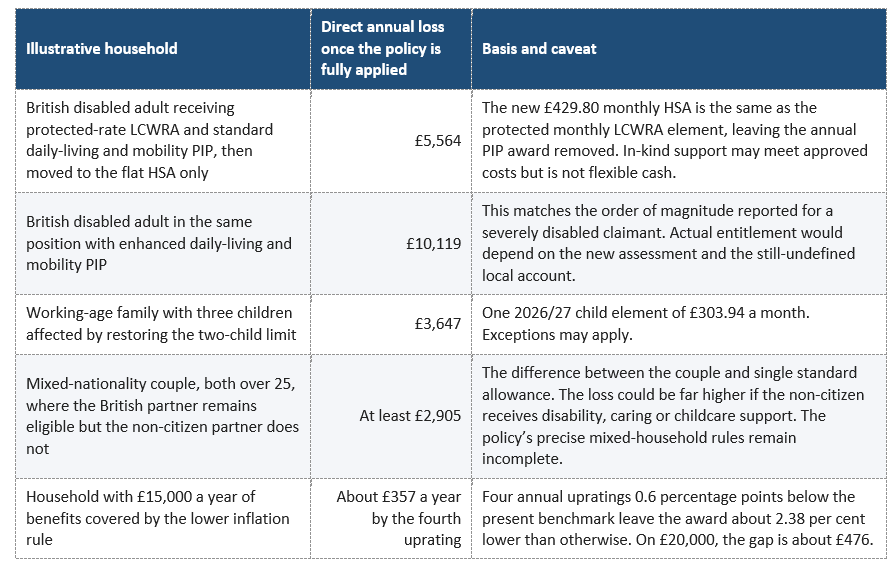
There is no honest basis for claiming that every Clacton benefit household would lose the same amount. Reform’s own rules create winners, protected cases and losers. We can, however, test the local scale. The Resolution Foundation estimated an average £4,200 annual loss for households affected only by a smaller PIP restriction. If just one-third of Clacton’s current PIP caseload lost that amount, around £14.6 million a year would disappear from disabled residents’ incomes. If half were affected, the figure would be £21.9 million. That is a sensitivity range, not a forecast. It also excludes child-benefit restrictions, citizenship rules and slower uprating.
Much of that money is currently spent locally on food, heating, taxis, mobility, care, rent and small services. A Treasury saving can therefore become lower takings for Clacton businesses, higher rent arrears for landlords and housing associations, and greater demand at the council, NHS and voluntary sector.

What lands on councils
Reform’s paper makes local government central to delivery while treating it mainly as an administrative channel.
For revenues and benefits teams, the citizenship rule would interact with Council Tax Reduction, pension-age Housing Benefit, Discretionary Housing Payments, council-tax arrears and data feeds from DWP. Mixed-nationality households would require new decision rules. Every unclear national rule would become a local query, reconsideration, complaint or appeal.
For housing teams, the immediate route from lost Universal Credit or Housing Benefit is rent arrears, possession action and homelessness applications. Councils already spent £2.8 billion on temporary accommodation in 2024/25, with more than 132,000 households in temporary accommodation. Housing authorities have legal duties to assess, prevent and relieve homelessness for eligible applicants, with stronger accommodation duties for households containing children or people vulnerable through old age, mental illness or disability. Those duties do not vanish because DWP has saved money.
For adult social care, the proposed Disability Support Accounts are a new local benefit and commissioning system. Councils would need assessors, evidence standards, supplier arrangements, reviews, audit, fraud controls and an appeals route. At the same time, people losing PIP could request Care Act assessments, equipment, home adaptations, transport or personal care. This lands on a sector where the Local Government Association reports that 33 social-care councils needed exceptional financial support in 2026/27.
For children’s services, removing benefits from non-citizen parents does not remove the child. The government’s own No Recourse to Public Funds guidance states that section 17 of the Children Act applies regardless of a child’s immigration status. Where a child is in need, a council may have to provide accommodation and subsistence. This is the purest example of cost shifting: a national benefit is removed, then a more expensive and administratively intensive local safety net is required.
Older people are partly protected, and that should be stated clearly. Reform does not propose to remove a contributory State Pension from someone who has earned it, and British pensioners are not the main target of the £50 billion package. But a long-settled non-citizen pensioner could lose Pension Credit, Housing Benefit or Attendance Allowance. British older people would still feel secondary effects if carers lose support, disability services are rationed or council budgets are diverted into emergency accommodation and crisis work.
Sweden is a warning about reciprocity and hard rules
Recent cases involving British citizens in Sweden are not welfare cases and should not be misrepresented as such. They concern late applications for post-Brexit residence rights. Their relevance is different: they show what happens when a treaty guarantee is converted into a hard administrative deadline and officials have little room to recognise a life built over decades.
Joyce Thomas, 78, was told to leave after 21 years in Sweden. Horace Mason, 74, who had lived there for 25 years and was in full-time care with vascular dementia and parkinsonism, also faced removal. Kathleen Poole faced removal from a dementia care home and died before the action was completed. In 2024 Sweden refused 27.5 per cent of post-Brexit residence applications, compared with an EU average of 3 to 4 per cent.
The lesson is not that Britain must never change any rule. It is that reciprocity, legal certainty and discretion are part of the policy, not footnotes. Reform says it would renegotiate or disapply parts of the Withdrawal Agreement to impose its citizenship rule. Its own model assumes that 10 per cent of roughly 1.3 million Britons living in the EU might return and claim benefits, for which it sets aside £500 million. That is about £3,850 per assumed returnee before considering housing, health, social care, legal disputes or the loss of an established life abroad.
If the government tells long-settled Europeans in Britain that years of work and tax payment no longer count, it cannot be surprised when British residents abroad ask whether their own protections will be treated as negotiable.
What a serious welfare plan would publish next
Reform has moved beyond a web-page slogan, but it has not yet crossed the line into an implementation-ready programme. Before voters are asked to accept a £50 billion transformation, the party should publish at least six further documents:
1. Draft legislative clauses or a detailed heads-of-bill paper, including the legal route for changing settled-status and Withdrawal Agreement rights.
2. A distributional, poverty, child-poverty and equality impact assessment, showing effects by disability, age, family type, tenure, work status, nationality and region.
3. A local-government New Burdens assessment covering workfare, Disability Support Accounts, revenues and benefits, homelessness, children’s services and adult social care.
4. A decision and appeals framework: evidence standards, notice periods, interim payments, hardship protection, tribunal rights and discretion for exceptional cases.
5. Pilots with published evaluation criteria, especially for workfare and the new disability assessment, followed by independent fiscal scoring.
6. A reciprocal-rights assessment for British citizens abroad, with realistic provision for return, housing and care rather than a single contingency line.
None of this is an argument for leaving welfare unchanged. It is an argument for treating citizens as people governed by law, not cells in a spreadsheet. Reform is entitled to argue that the present balance between contribution, need and obligation is wrong. It is not entitled to present a central-account saving as if the social and economic costs disappear.
The political sting is that the consequences would not fall mainly on a distant class of “undeserving” strangers. They would fall on British disabled people, carers, low-paid workers, larger families, council tenants, private renters and low-income pensioners, including many in the places where Reform is strongest.
If Reform enters government and enacts this plan as written, its own supporters will be among those who suffer the consequences of high-concept policy meeting complicated reality. That is not a reason to gloat at them. It is a reason to demand the authorities, methodology, safeguards and local funding before the slogans become law.
Sources and further reading
• Reform UK, Making Welfare Work, August 2026.
• Institute for Fiscal Studies, “Reform UK’s plan for welfare: IFS response”, 17 August 2026.
• Resolution Foundation, No workaround, 20 May 2025.
• Department for Work and Pensions, Benefit and pension rates 2026 to 2027.
• Ministry of Justice, Tribunal Statistics Quarterly, January to March 2026.
• Office for National Statistics, How life has changed in Tendring: Census 2021.
• House of Commons Library, Constituency data: Universal Credit claimants and PIP claimants.
• Local Government Association, Temporary accommodation costs and Care Where We Live.
• UK Government, cross-government NRPF guidance for councils.
• The Guardian, analysis of post-Brexit removal cases in Sweden, 15 August 2026.